

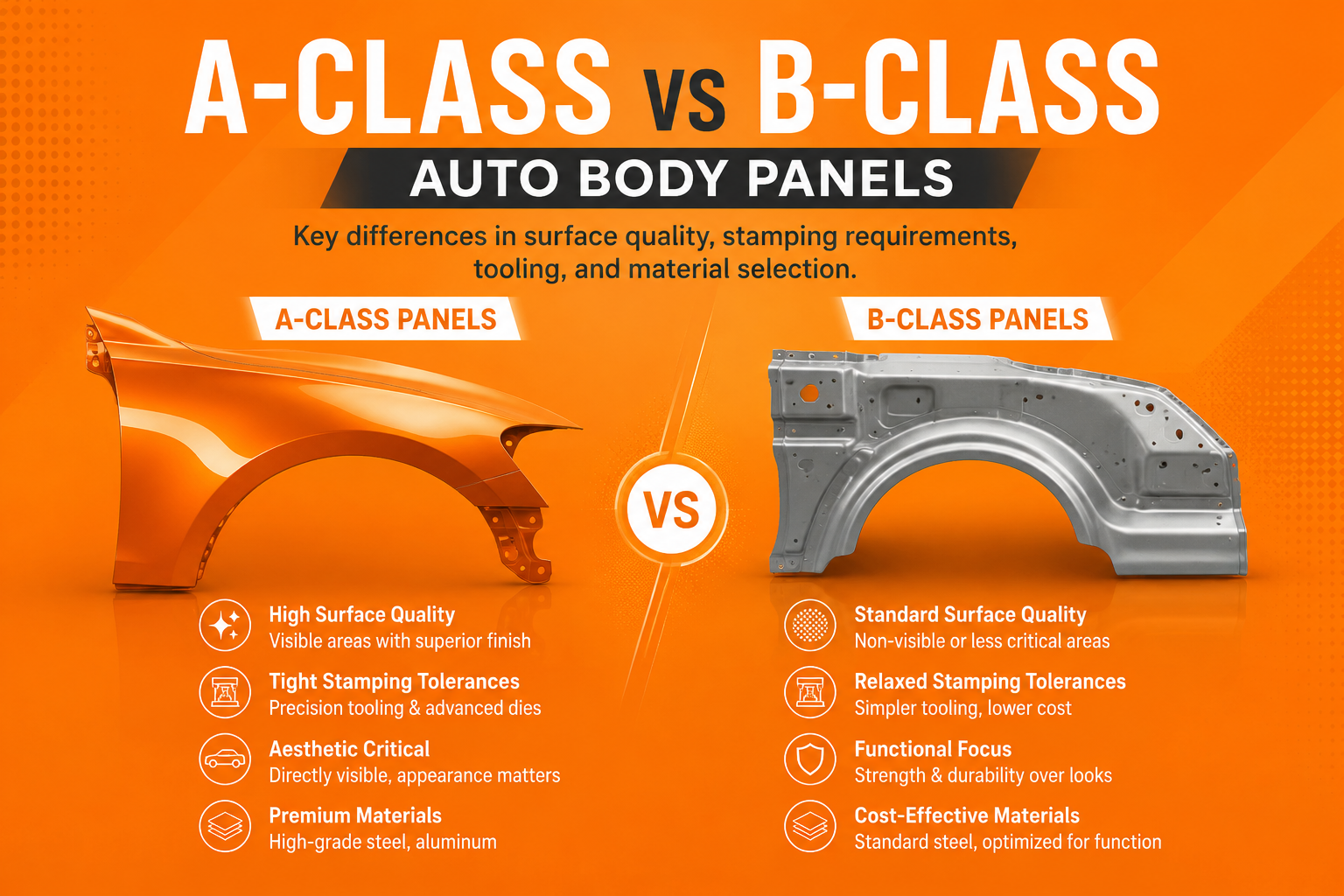
In automotive manufacturing, not all body panels are created equal. The classification of panels into A-class and B-class is a critical distinction that shapes every decision — from material selection and die design to surface finishing and quality inspection. Understanding this difference is essential for stamping engineers, die makers, and OEM suppliers aiming to deliver flawless vehicle bodies.
What Are Automotive Body Panel Classifications?
Automotive body panels are categorized based on their visibility, surface finish requirements, and functional role on a vehicle. The two primary classifications are:
- A-Class Panels — Exterior visible surfaces judged directly by the customer
- B-Class Panels — Structural or semi-visible surfaces with less stringent cosmetic demands
This classification system directly governs tooling specifications, steel grade selection, stamping process parameters, and inspection standards across the entire supply chain.
What Are A-Class Automotive Body Panels?
A-class panels are the outermost, fully visible surfaces of a vehicle — the panels a customer sees and touches before making a purchase decision. These surfaces must meet the highest cosmetic and dimensional standards in the industry.
Common A-Class Panels Include:
- Hood (bonnet)
- Front and rear doors (outer skins)
- Front fenders
- Roof panel
- Trunk lid / tailgate outer skin
- Quarter panels
Key Characteristics of A-Class Panels:
- Zero tolerance for surface defects (waviness, pits, scratches, die lines)
- Mirror-like reflective quality after painting
- Tight dimensional tolerances (typically ±0.5 mm or better)
- High draw quality (HDQ) or extra deep draw quality (EDDQ) steel grades used
- Stringent orange-peel and highlight distortion standards
What Are B-Class Automotive Body Panels?
B-class panels are structural or partially hidden components that contribute to the vehicle's rigidity, crash performance, and assembly integrity — but are not directly visible to the end customer in normal use.
Common B-Class Panels Include:
- Door inner panels
- Floor pan sections
- Firewall / dash panel
- Roof inner reinforcements
- Pillar inners (A, B, C pillars)
- Wheel arch liners (inner)
Key Characteristics of B-Class Panels:
- Functional performance prioritized over cosmetic finish
- Higher-strength steels (HSS, AHSS, UHSS) commonly used
- Greater forming complexity tolerated
- Surface appearance secondary — corrosion protection is key
- Dimensional tolerances slightly relaxed compared to A-class
A-Class vs B-Class Panels — Side-by-Side Comparison
B-Class: Hidden or semi-visible
B-Class: Functional, cosmetic not critical
B-Class: HSS, DP, TRIP, UHSS grades
B-Class: 340–1500+ MPa
B-Class: ±0.8 mm to ±1.5 mm
B-Class: Ra 0.8–1.6 µm acceptable
B-Class: High (especially UHSS)
B-Class: Cracking, springback, fracture
B-Class: CMM, functional fit checks
B-Class: Optimized for strength/weight
Why Does This Classification Matter for Stamping?
The A-class vs B-class distinction has profound implications at every stage of the stamping process.
1. Die Surface and Polish Requirements
A-class dies must be polished to an extremely fine surface finish — often Ra ≤ 0.4 µm — because any imperfection in the die face transfers directly to the panel surface and becomes visible after paint. B-class dies can tolerate a rougher working surface, reducing polishing time and tooling cost.
2. Steel Grade and Formability
A-class panels use softer, highly formable steel grades such as Drawing Quality Special Killed (DQSK), High Draw Quality (HDQ), or Bake Hardening (BH) steels. These grades offer excellent surface quality and deep drawability. B-class panels increasingly use Advanced High-Strength Steel (AHSS) or Ultra-High-Strength Steel (UHSS) where structural performance outweighs cosmetic needs.
3. Lubrication and Blank Preparation
For A-class panels, mill-applied pre-lube or clean stamping lubricants are used to prevent surface scratching during forming. Any contamination on the blank surface can cause micro-pits or die pickup that ruins the part. B-class panels are more tolerant of standard lubricants and blank handling variations.
4. Springback Management
B-class panels — particularly structural UHSS components — experience far greater springback than A-class panels stamped from softer steels. This requires dedicated springback compensation strategies in die design, whereas A-class tooling focuses more on surface geometry accuracy and draw bead optimization.
5. Quality Inspection Standards
A-class surfaces are inspected using high-resolution optical scanning, reflection analysis under specialized lighting (Zebra boards or oil-stone checking), and surface waviness gauges. B-class panels are primarily measured for dimensional accuracy and fit using coordinate measuring machines (CMM) or functional assembly checks.
Material Selection Summary by Panel Class
Typical Application: Door outers, hood, fenders
Typical Application: Roof, door skins, hoods
Typical Application: Door inners, rails, pillars
Typical Application: Crash members, floor structures
Typical Application: A/B/C pillar inners, sill reinforcements
Typical Application: Wheel arches, bumper beams
How Tooling Strategy Differs Between A-Class and B-Class
At Dai-Ichi Tools, our engineers understand that A-class and B-class panels demand fundamentally different tooling philosophies:
For A-class tooling, the focus is on achieving flawless surface transfer, controlling material flow uniformly, and eliminating any tool-surface artifact that could appear after paint. This means premium die steel grades, hand-polished working surfaces, and rigorous tryout and validation protocols.
For B-class tooling, the priority shifts toward wear resistance, strength, and dimensional repeatability under high forming loads. Carbide-tipped punches, PVD-coated surfaces, and robust die construction are critical — especially when forming AHSS and UHSS grades that generate extreme contact pressures.
Frequently Asked Questions (FAQs)
Q1: Can the same die steel be used for both A-class and B-class panels? Not always. A-class dies typically use cast iron (GGG70L) or special die steels capable of achieving a very fine polish. B-class dies often require tougher, more wear-resistant tool steels or carbide inserts due to the higher forming forces involved with AHSS/UHSS materials.
Q2: Why do A-class panels use softer steel grades? Softer, high-formability steel grades offer superior surface quality, lower risk of orange peel after painting, and excellent deep drawability. Since A-class panels are cosmetic rather than structural, the trade-off of lower strength for better surface quality is fully acceptable.
Q3: What is "orange peel" in A-class panel quality? Orange peel is a textured surface appearance that resembles the skin of an orange. It results from coarse grain size in the steel or improper forming conditions. It becomes visible after painting and is considered a critical defect on A-class surfaces.
Q4: Are B-class panels structurally more important than A-class panels? Generally, yes. B-class panels — particularly pillars, floor pans, and firewall structures — are the primary load-bearing and crash-energy-absorbing components of the vehicle body. Their mechanical performance directly impacts occupant safety.
Q5: How does paint affect A-class panel quality evaluation? Paint magnifies surface imperfections. A defect invisible on a bare stamped panel can become clearly visible under reflective paint, especially in metallic or gloss finishes. This is why A-class panels are inspected under specialized lighting both before and after painting.
Q6: What role do draw beads play in A-class panel forming? Draw beads control material flow during the deep draw process. For A-class panels, draw bead geometry must be precisely optimized to prevent surface defects like splits, wrinkles, or excessive thinning — all of which compromise final surface appearance.
Conclusion
The distinction between A-class and B-class automotive body panels goes far beyond simple visibility. It governs steel selection, die engineering, surface treatment, lubrication strategy, and inspection methodology across the entire stamping process. Misunderstanding this classification — or applying the wrong tooling approach — directly impacts vehicle quality, production efficiency, and customer satisfaction.
At Dai-Ichi Tools, we engineer precision stamping tools tailored to the exact demands of both A-class and B-class panel production. From mirror-polished draw dies for exterior skins to wear-resistant UHSS tooling for structural components, our solutions are built to perform at the highest level of automotive manufacturing.
Explore our tooling solutions at dai-ichitools.com or contact our engineering team today.