
When an automotive programme team evaluates a die quotation, the number they focus on first is the tooling build cost. It is the most visible number, the most comparable between suppliers, and the most immediately relevant to the capital budget being approved.
It is also one of the least useful numbers for making a sound tooling investment decision.
The tooling build cost is what you pay once. The total cost of ownership — TCO — is what the die costs you across its entire production life. And for automotive stamping dies running at 100,000 to 500,000 parts per year over a five to eight year programme, the difference between a low-TCO die and a high-TCO die consistently dwarfs the difference in initial tooling cost.
Understanding how to calculate TCO for automotive stamping dies — and what drives it up or down — is one of the most practically valuable analytical skills a stamping programme manager or procurement engineer can develop.
What Total Cost of Ownership Means for Stamping Dies
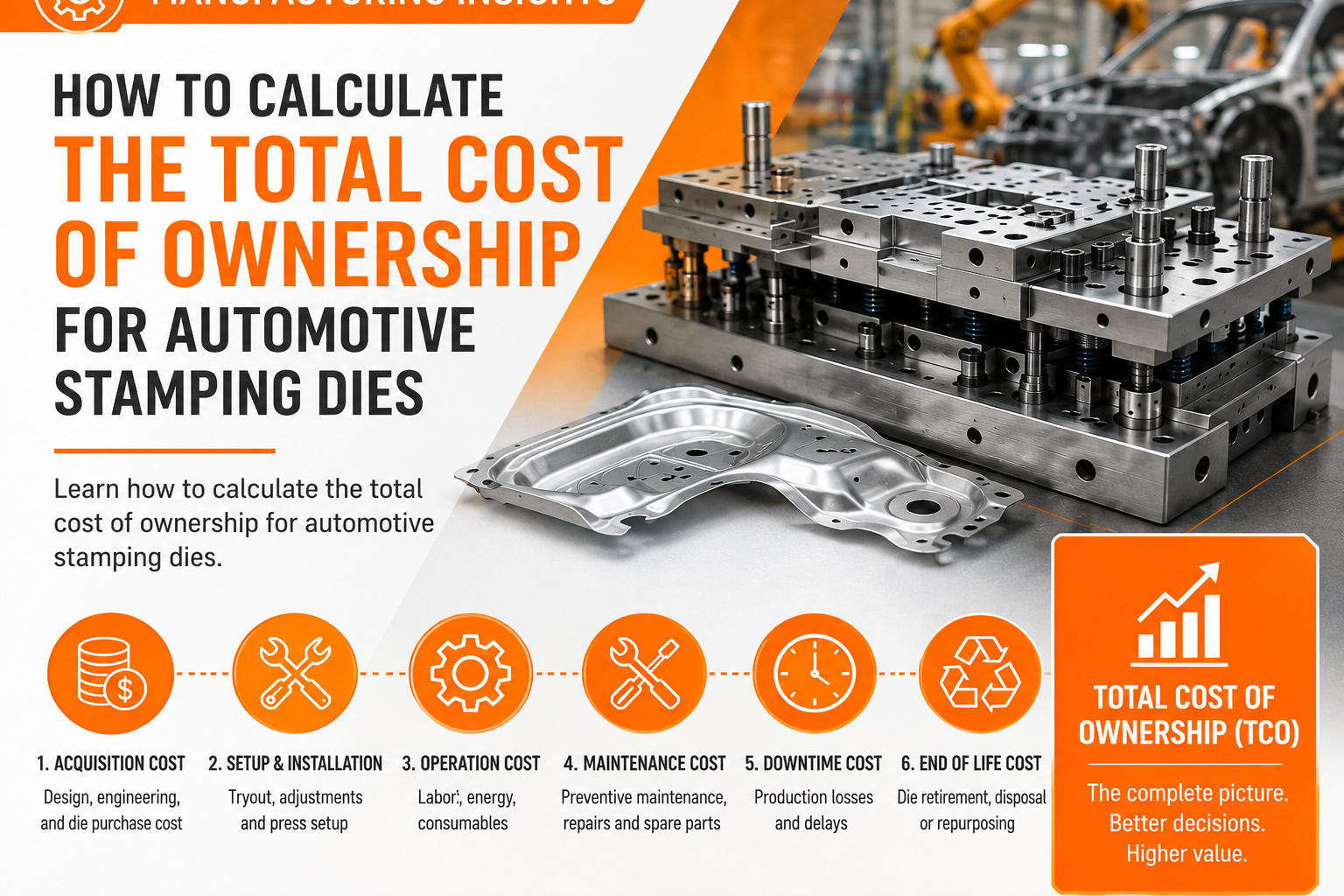
Total cost of ownership for an automotive stamping die is the sum of every cost associated with the die from the point of tooling award to the end of programme production. It includes:
- Tooling build cost
- Tryout and prove-out cost
- Engineering change cost during development and production
- Production maintenance and repair cost
- Consumable insert replacement cost
- Production scrap and rework cost attributable to tooling
- Downtime cost from unplanned die failures
- End-of-programme refurbishment or disposal cost
The first item — tooling build cost — typically represents 35 to 55 percent of total TCO for a well-managed programme on a conventional HSS material. For AHSS programmes with higher tryout complexity and faster insert wear, the tooling build cost proportion falls further — meaning that the costs after build represent the majority of what the die actually costs across its life.
TCO Component 1 — Tooling Build Cost
The tooling build cost is the die manufacturer's quotation — covering design, material, machining, assembly, and initial tryout. For a transfer die on a structural automotive part, build costs range from ₹40 lakh to ₹2 crore or above depending on part complexity, material grade, number of stations, and the specification of inserts and coatings required.
Build cost is the most visible TCO component — but the most important cost driver embedded within it is simulation. A tooling build that includes rigorous AutoForm simulation — springback compensation, process window definition, blank optimisation — costs 3 to 8 percent more than one without. That 3 to 8 percent premium consistently saves 20 to 40 percent of total TCO by reducing tryout iterations and production instability downstream.
Specification decisions at build stage — insert material grade, surface coating specification, die structure sizing for AHSS loads — have an outsized effect on every subsequent TCO component. A die built with correctly specified D2 inserts and PVD coating costs more upfront and lasts three to five times longer in production than one built with underspecified inserts.
TCO Component 2 — Tryout and Development Cost
Tryout cost is the cost of all press time, engineering labour, material, and rework between first blank and customer approval. For a well-simulated programme on conventional HSS, tryout cost is typically 8 to 15 percent of build cost. For an AHSS programme without simulation, tryout cost can exceed build cost — multiple correction cycles on 980 MPa material, each requiring weld-and-remachine cycles on die faces, add up rapidly.
The formula is straightforward: every additional tryout iteration on a transfer die costs ₹3 to ₹12 lakh depending on die size — covering press time, engineering labour, and rework machining. A programme that requires four tryout iterations instead of two adds ₹6 to ₹24 lakh to TCO before production begins.
Simulation investment that reduces tryout from four iterations to two — a consistently achievable improvement on programmes where simulation was not used — pays back its cost many times over in tryout savings alone.
TCO Component 3 — Engineering Change Cost
Engineering changes — modifications to the die driven by part design changes after tooling build — are a significant TCO component on programmes with late or frequent design changes. Each engineering change requires die design revision, potential remachining of affected components, and a re-tryout cycle to validate the changed geometry.
The cost per engineering change on a transfer die ranges from ₹1 lakh for a simple pierce punch addition to ₹20 lakh or above for a draw die face modification on an AHSS programme. Programmes with three to five engineering changes between tooling build and SOP — common on complex body structure programmes — can add 15 to 30 percent to total TCO.
The mitigation is early and thorough DFM — catching part design issues before tooling is built rather than resolving them through engineering changes after.
TCO Component 4 — Production Maintenance and Insert Replacement
In production, dies require planned preventive maintenance at defined stroke intervals and unplanned corrective maintenance when components wear or fail. For a transfer die running at 150,000 parts per year, annual maintenance costs range from ₹5 lakh to ₹25 lakh depending on material grade and die specification.
The primary maintenance cost drivers are:
Pierce and trim insert replacement: The most frequent consumable cost. On mild steel programmes with correctly specified D2 inserts, pierce punch replacement intervals of 300,000 to 500,000 strokes are achievable. On 980 MPa AHSS with tool steel inserts, replacement intervals can fall to 50,000 to 100,000 strokes — multiplying annual insert cost by 3 to 5 times compared to mild steel.
Upgrading to carbide inserts on AHSS trim and pierce operations increases insert unit cost by 4 to 8 times but extends replacement intervals by 5 to 10 times — a TCO-positive investment that every AHSS programme should evaluate at build specification stage.
Draw die surface maintenance: Galling, abrasive wear, and localised damage on draw die working surfaces require periodic polishing, re-coating, and occasional weld-and-remachine correction. Surface coating — PVD TiN or TiCN on draw faces — reduces maintenance frequency significantly on AHSS and aluminium programmes.
TCO Component 5 — Production Scrap and Downtime Cost
The most underestimated TCO component is the cost of parts rejected due to die-related dimensional deviation or surface defects, and the cost of production downtime caused by unplanned die failures.
On a programme running at 200,000 parts per year with a part value of ₹800 per stamping, a 0.5 percent scrap rate attributable to die dimensional instability costs ₹8 lakh per year. A die that runs at 0.1 percent scrap saves ₹6.4 lakh annually compared to one running at 0.5 percent — a saving that compounds across the programme life.
Unplanned press downtime from insert breakage, scrap retention damage, or transfer mechanism failure typically costs ₹50,000 to ₹3 lakh per incident in lost production and emergency repair — before accounting for customer delivery penalties on just-in-time supply programmes.
The mitigation for both is the same: correct die specification at build, rigorous tryout to validate process stability, and a documented process window that keeps production parameters within the range where the die performs consistently.
TCO Calculation Framework
Use this framework to estimate and compare TCO between tooling options:
High-TCO Die: Lower — underspecified, no simulation
High-TCO Die: 25–60% of build — 3 to 6 iterations
High-TCO Die: High — late changes drive rework
High-TCO Die: Higher — frequent insert replacement
High-TCO Die: Higher — dimensional instability in production
High-TCO Die: Higher — unplanned failures from wear
High-TCO Die: Higher total despite lower build cost
The consistent finding across automotive TCO analysis is that the die with the lower build cost almost never has the lower total cost of ownership — because the costs saved at build are recovered many times over in tryout, maintenance, scrap, and downtime across the programme life.
FAQs: Total Cost of Ownership for Stamping Dies
What is the single biggest driver of high TCO in stamping dies? Insufficient simulation at the die development stage is the single biggest driver of high TCO. It directly increases tryout cost, increases the probability of production dimensional instability, and often results in a die whose process window is too narrow to maintain consistent part quality across coil-to-coil material variation — generating scrap and downtime that accumulate across the entire programme life.
How does material grade affect TCO? Material grade has a direct and significant effect on TCO. AHSS grades above 590 MPa increase tryout complexity and cost through springback severity, increase insert replacement frequency through accelerated wear, and increase draw die maintenance cost through galling risk. A correctly specified AHSS die — with simulation compensation, premium inserts, and PVD coating — will have a higher build cost but a lower TCO than an incorrectly specified AHSS die where underspecification at build stage drives costs throughout production.
Should TCO be presented to customers as part of a tooling quotation? Yes — and at Dai-Ichi Tools, we actively support TCO discussions with customers when evaluating tooling specifications. A customer who understands that upgrading from tool steel to carbide inserts at ₹3 lakh additional build cost saves ₹15 lakh in annual insert replacement on an AHSS programme will make a better decision than one who sees only the build cost line. TCO-informed specification decisions consistently deliver better programme outcomes for both supplier and customer.
Specify for TCO — Not Just for Build Cost
The lowest-cost die quotation and the lowest total cost of ownership are rarely the same thing. Across a five to eight year automotive programme at volume, the difference between a low-TCO and high-TCO die is measured in crores — not lakhs.
At Dai-Ichi Tools, every programme quotation is built on specifications designed for programme-life performance — AutoForm simulation to reduce tryout, correct insert specification for the material grade, PVD coating where wear and galling risk justify it, and process window validation that supports production stability from day one.
If you have a programme to quote and want to understand the TCO implications of different tooling specifications before committing build budget, our engineering team is ready to walk through the numbers with you.
What every Dai-Ichi programme delivers for TCO:
- AutoForm R12 simulation — reduces tryout cost and production instability
- Correctly specified D2, SKD11, and carbide inserts by material grade
- PVD and TD coating where wear data justifies the investment
- Process window documentation — reduces production scrap and downtime
- In-house tryout up to 1,600 tonnes — eliminates third-party tryout delays
- CMM and FARO scanner validation before dispatch
📍 Dai-Ichi Tools — Faridabad, India