
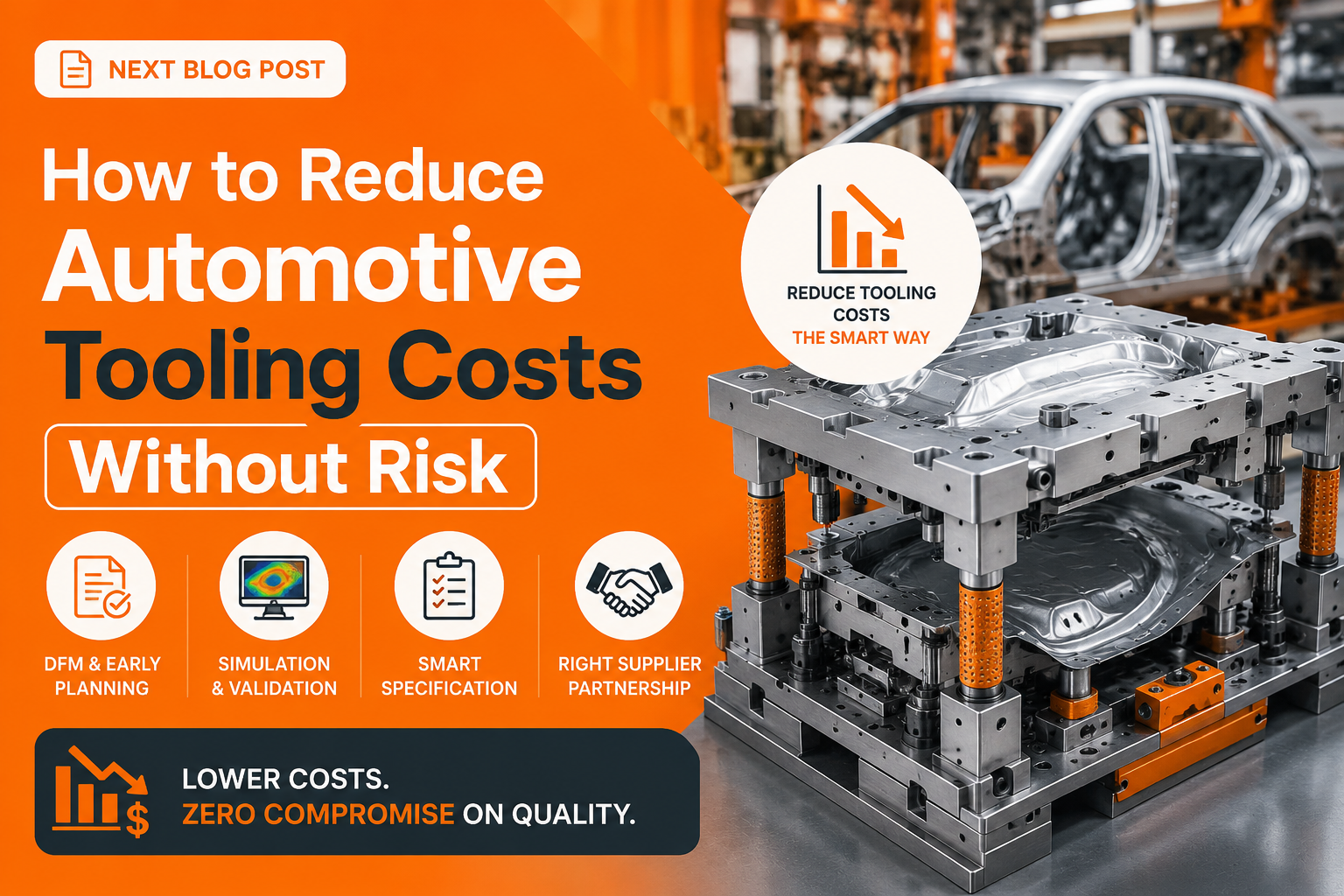
Every automotive programme operates under tooling cost pressure. Whether you are a Tier-1 supplier managing a tight programme budget or an OEM procurement team benchmarking tooling quotations across multiple suppliers, the question is always the same — where can tooling cost be reduced without creating the quality and programme delivery problems that cost reductions in the wrong places reliably produce?
The answer is not straightforward. Tooling cost reduction done well delivers genuine programme savings without affecting die quality, dimensional compliance, or production stability. Tooling cost reduction done badly produces dies that look cheaper on the purchase order and cost significantly more across the programme life in tryout failures, production scrap, insert replacement, and unplanned downtime.
The difference between the two is understanding exactly where tooling cost comes from — and consequently where it can be reduced safely and where it cannot.
At Dai-Ichi Tools, we have worked through this analysis on hundreds of automotive die programmes. This guide identifies the strategies that genuinely reduce tooling cost without compromising quality — and the false economies that appear to save money but consistently do not.
Strategy 1 — Invest in DFM Before the Tooling Budget Is Set
The most effective tooling cost reduction strategy is also the earliest one — and the most frequently skipped under programme schedule pressure.
DFM — Design for Manufacturability — conducted before die design begins identifies every part geometry feature that will add unnecessary complexity, cost, or risk to the tooling programme. Tight radii that will crack at tryout. Holes positioned too close to flange lines that will distort during forming. Negative draft angles requiring expensive cam mechanisms. Flange geometry generating severe springback that requires additional restrike stations.
Every one of these issues, identified at DFM stage, can be resolved by a minor part design modification that costs hours of engineering time. The same issue discovered at die design stage costs days of rework. Discovered at tryout, it costs weeks and significant budget.
On a typical structural automotive part, DFM routinely identifies 3 to 6 geometry issues that — if resolved before tooling design begins — reduce die complexity, eliminate one or two stations from the forming sequence, and reduce tooling build cost by 8 to 15 percent. These are not compromises. They are engineering improvements that make the part easier to produce without affecting its functional performance.
The cost reduction: Simpler die with fewer stations, less complex tooling, and significantly reduced tryout risk — without any reduction in part quality or die capability.
Strategy 2 — Use Simulation to Reduce Tryout Iterations
Tryout cost is the most consistently underestimated line item in automotive tooling budgets. Each additional tryout iteration on a transfer die — press time, engineering labour, material, and rework machining — adds ₹3 to ₹12 lakh to programme cost depending on die size and material grade. A programme that requires four tryout iterations instead of two adds ₹6 to ₹24 lakh before production begins.
AutoForm simulation — covering draw feasibility, springback prediction, and die geometry compensation before machining begins — consistently reduces tryout iterations from the industry average of 3 to 5 cycles to 1 to 2 cycles on well-simulated programmes. The simulation investment represents 3 to 8 percent of build cost. The tryout saving it generates represents 20 to 40 percent of build cost on complex programmes.
This is not a marginal improvement. On an AHSS programme where unguided springback correction can add 4 to 6 tryout cycles — each requiring weld-and-remachine correction of die faces — the simulation investment is the single highest-return cost reduction available in the entire tooling budget.
The cost reduction: Fewer tryout iterations, faster customer approval, earlier SOP — saving multiples of the simulation fee in press time, rework, and programme delay cost.
Strategy 3 — Optimise Blank Size Through Simulation
Material cost is often the largest single production cost on an automotive stamping programme — exceeding tooling cost within the first year of volume production on most programmes. Blank size directly determines material cost per part, and blank size is almost always set conservatively — over-sized as a safety margin — when it is not derived from simulation.
AutoForm blank optimisation calculates the minimum blank size that produces a defect-free part across all forming operations. On a typical structural automotive part, simulation-optimised blanks are 3 to 8 percent smaller than conservatively set blanks. On a programme running 200,000 parts per year in 780 MPa AHSS at ₹95 per kilogram, a 5 percent blank reduction saves ₹20 to ₹40 lakh annually — every year of the programme life.
This saving requires no compromise in part quality, no change in die specification, and no production process modification. It is purely an engineering optimisation that is only achievable when blank development is done through simulation rather than experience-based estimation.
The cost reduction: Lower material cost per part from programme launch — compounding across every year of production volume.
Strategy 4 — Specify Inserts Correctly for the Material Grade
Insert specification — the material grade and surface treatment applied to die working surfaces — is one of the most important and most frequently mishandled cost decisions in automotive tooling. Both over-specification and under-specification cost money. Getting it right saves money at both build and production stages.
Under-specified inserts — tool steel where carbide is warranted, uncoated surfaces where PVD coating is required — produce accelerated wear and frequent replacement in production. On 980 MPa AHSS, tool steel pierce punches may require replacement every 50,000 strokes. Carbide punches at the same station may run 400,000 strokes between replacements — at 4 to 6 times the insert unit cost but 8 times the replacement interval. The production TCO of carbide is consistently lower.
Over-specified inserts — carbide on mild steel applications where D2 tool steel is entirely adequate — add build cost without providing any production benefit. Carbide's brittleness makes it a liability in applications with impact loading conditions that D2 handles reliably.
The correct approach is material-grade-specific insert specification — D2 for mild steel and conventional HSS, upgraded tool steel with PVD coating for AHSS to 780 MPa, carbide for trim and pierce on 980 MPa and above. This specification discipline reduces both unnecessary build cost and unnecessary production maintenance cost simultaneously.
The cost reduction: Lower annual insert replacement cost in production — achieving positive TCO versus both over-specification and under-specification alternatives.
Strategy 5 — Consolidate Stations Where Part Geometry Allows
Station count is one of the strongest drivers of transfer die build cost. Each additional station adds die design time, cast iron material, machining hours, and assembly time to the programme. Consolidating two operations into a single station — where part geometry, press stroke, and forming loads allow — reduces build cost without affecting part quality.
Common consolidation opportunities identified at DFM and die design stage include:
- Combining primary pierce and initial trim operations at a single station where the pierce pattern and trim line are not in conflict
- Combining secondary flange and emboss operations where forming loads are compatible
- Combining restrike and final coining where springback correction and datum coining can be achieved in a single tool
Station consolidation is not always possible — part geometry, press bed length, and tonnage constraints limit what can be combined. But it is always worth evaluating systematically at the die design stage. Eliminating one station from a 7-station transfer die typically reduces build cost by 10 to 15 percent.
The cost reduction: Lower tooling build cost from reduced station count — with no effect on part quality or forming capability when consolidation is properly engineered.
Strategy 6 — Choose the Right Supplier — Not the Cheapest Quotation
The most expensive tooling cost reduction strategy in automotive manufacturing is selecting a supplier on the basis of the lowest initial quotation without verifying the capability behind it.
A tooling quotation that is 20 percent lower than market rate is almost always lower because something has been removed — simulation depth, insert specification, machining accuracy standards, or tryout thoroughness. Each of these omissions transfers cost from the supplier's build quotation to the customer's tryout budget, production scrap account, and maintenance schedule.
The supplier selection criteria that reliably identify low-TCO tooling sources are simulation capability integrated into die design workflow, 5-axis machining capability adequate for die face accuracy requirements, in-house tryout presses of sufficient tonnage, and CMM inspection before dispatch. These are verifiable capability indicators — not marketing claims — and they predict programme delivery and production performance more reliably than quotation price.
The cost reduction: Lower total programme cost through faster tryout, lower production scrap, and fewer unplanned maintenance interventions — despite a higher or comparable initial quotation.
What Not to Cut: False Economies in Tooling Cost Reduction
Some apparent cost reductions reliably cost more than they save:
Actual Cost: 20–40% of build cost in additional tryout
Actual Cost: 3–5x higher annual insert replacement cost
Actual Cost: Production dimensional non-conformance, customer rejections
Actual Cost: 2–4 week delays per correction cycle versus in-house tryout
Actual Cost: 4–8 weeks at tryout when DFM issues surface
FAQs: Reducing Automotive Tooling Costs
Can tooling cost be reduced without changing the part design? Yes. Blank optimisation, station consolidation, correct insert specification, and simulation-driven tryout reduction all reduce tooling and programme cost without requiring part design changes. Part design changes identified through DFM offer additional savings — but tooling cost reduction is achievable even on programmes where the part design is already frozen.
How much can simulation realistically save on a complex AHSS programme? On a complex AHSS transfer die programme without prior simulation, 3 to 5 tryout iterations are typical. With rigorous AutoForm simulation, 1 to 2 iterations are consistently achievable. The saving from 2 to 3 fewer tryout iterations — each costing ₹5 to ₹12 lakh on a large transfer die — typically ranges from ₹10 to ₹30 lakh per programme. The simulation fee is typically ₹1.5 to ₹4 lakh. The return on investment is 5x to 15x on most AHSS programmes.
Does using a domestic Indian supplier automatically reduce tooling cost? Domestic sourcing reduces logistics cost, import duty, and communication overhead — and at capable Indian toolrooms, delivers tooling at 30 to 50 percent lower cost than equivalent Japanese or German sources at comparable technical standards. However, selecting an Indian supplier without verifying simulation capability, machining capacity, and tryout infrastructure produces the same false economy as selecting any supplier on price alone.
Reduce Cost Where It Is Safe — Protect Quality Where It Matters
Tooling cost reduction and tooling quality are not in conflict — but they require discipline about where cost is reduced and where it is protected. DFM, simulation, blank optimisation, and correct insert specification all reduce cost while improving programme outcomes. Cutting simulation, underspecifying inserts, and selecting on quotation price alone all appear to save money and consistently do not.
At Dai-Ichi Tools, every programme is engineered for TCO performance — simulation as standard, insert specification matched to material grade, DFM before die design begins, and in-house tryout to minimise correction cycles. If you want to understand where genuine cost reduction is available on your next tooling programme, our engineering team is ready to work through the numbers with you.
What every Dai-Ichi programme delivers:
- AutoForm R12 simulation — reducing tryout cost from programme start
- DFM review identifying cost reduction opportunities before build
- Blank optimisation delivering material savings from production launch
- Correct insert specification for build cost and production TCO balance
- In-house tryout up to 1,600 tonnes — no third-party scheduling delays
- 400+ dies annually — 15+ OEM and Tier-1 customers
📍 Dai-Ichi Tools — Faridabad, India