

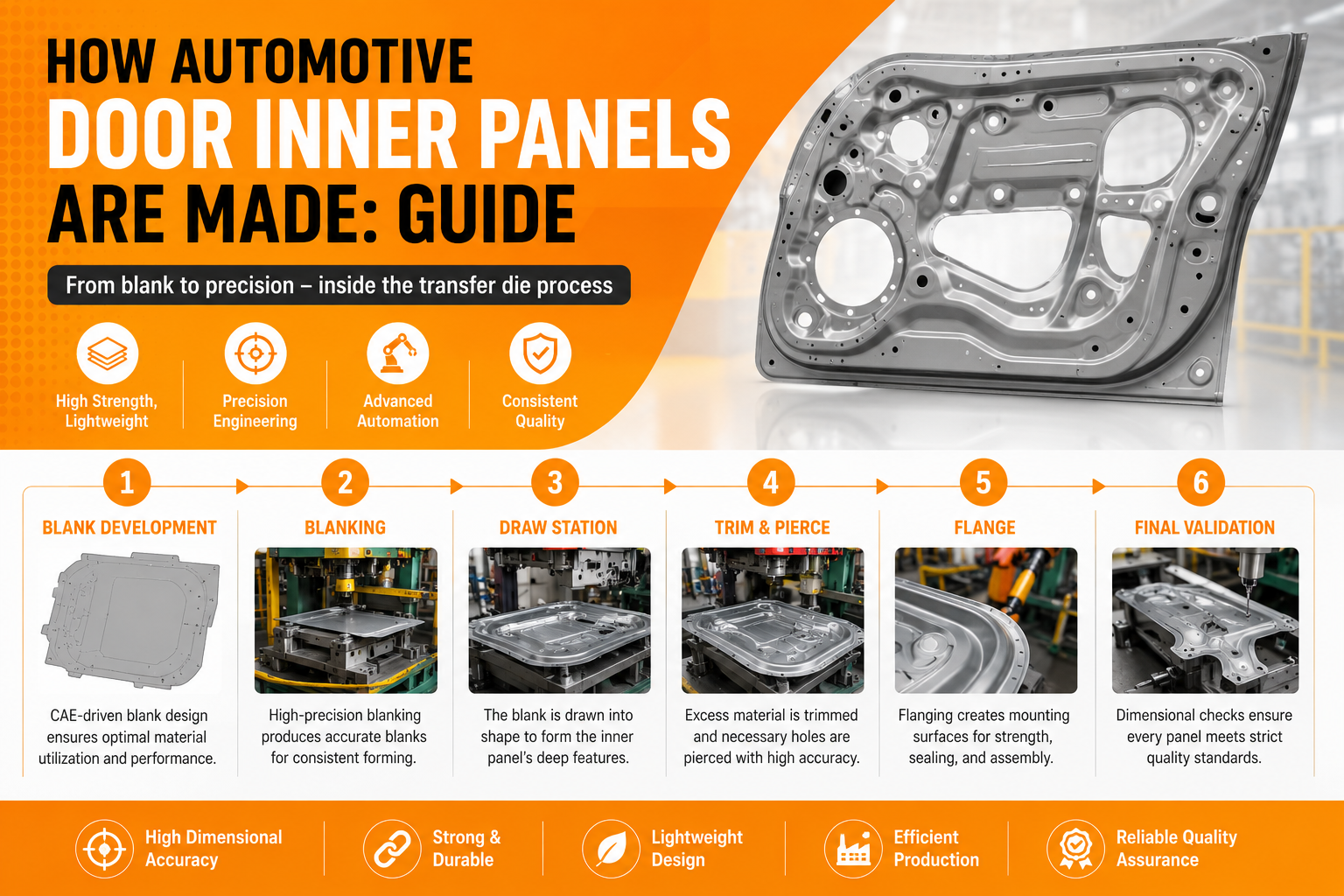
What Is a Door Inner Panel?
Before examining the production process, it is worth being precise about what a door inner panel is — because the term is used loosely in the industry and can refer to several different components.
The door inner panel — also called the door inner skin or door inner pressing — is the structural sheet metal forming that forms the inner face of the vehicle door assembly. It sits behind the door trim panel that the vehicle occupant sees and touches, and in front of the door outer skin that forms the visible exterior surface of the door.
The door inner panel performs several critical structural and functional roles:
- A-Class Panels — Exterior visible surfaces judged directly by the customer
- B-Class Panels — Structural or semi-visible surfaces with less stringent cosmetic demands
- It provides the primary structural backbone of the door assembly — supporting the door in the body aperture via hinge attachment points and transmitting door closing loads through the latch interface
- It carries the mounting interfaces for all door hardware — window regulator, door lock mechanism, speaker, mirror motor wiring, and impact beam brackets
- It provides the sealing surface for the door cavity — the membrane or sheet of plastic that separates the wet zone (outside of the inner panel) from the dry zone (inside the door trim)
- It contributes to side impact performance by providing a structural cross-section that works with the impact beam and door outer to manage crash energy
This classification system directly governs tooling specifications, steel grade selection, stamping process parameters, and inspection standards across the entire supply chain.
Why Transfer Dies Are Used for Door Inner Panels
Door inner panels are produced in transfer dies rather than progressive dies or tandem die lines for a combination of technical and economic reasons that make transfer dies the correct tooling choice for this part family.
Part complexity requires free-blank forming: Door inner panels have significant three-dimensional geometry — draw depths of 80 to 150 mm are common, with multiple flanges in different planes, large pierce patterns for hardware mounting, and complex curved surfaces that follow the door aperture geometry. This level of three-dimensional complexity cannot be achieved in a progressive die where the part must remain flat within a strip carrier throughout forming.
Part size suits transfer press configuration: Door inner panels for typical passenger cars range from approximately 600 mm to 900 mm in their longest dimension — within the practical capability of single-press transfer die configurations for most part geometries. Parts at the upper end of this size range may require tandem-linked transfer configurations, but the majority of passenger car door inner panels are producible on a single transfer press.
Volume economics favour transfer dies: Door inner panels for passenger car programmes typically run at 80,000 to 300,000 parts per year — volume levels at which transfer die economics are well-suited. The tooling investment for a transfer die on a single press is significantly lower than a tandem die line, and the single-press operational simplicity reduces production cost compared to a multi-press tandem line at these volume levels.
Dimensional precision requirements suit transfer die control: The assembly interfaces on a door inner panel — hinge hole positions, latch striker hole position, and perimeter flange geometry — must be held to tight tolerances because they directly affect door fit and function on the vehicle. A transfer die, with all forming stations sharing a common die reference datum, provides better dimensional stack-up control than a tandem line where each press introduces independent positioning variation.
Stage 1 — Part Design Review and DFM
Every door inner panel transfer die programme at Dai-Ichi Tools begins with a formal DFM — Design for Manufacturability — review before any die design work begins.
What DFM Covers for Door Inner Panels
Draw depth and draw ratio assessment: Door inner panels combine a relatively large plan area with significant draw depth — a combination that produces high draw ratios at the corners of the panel where material must flow the greatest distance into the die cavity. DFM checks the draw depth-to-plan-area ratio at all critical locations and identifies corners or local features where material thinning will approach or exceed the forming limit of the specified material grade.
Minimum radius compliance: All internal radii on the part drawing are checked against the minimum forming radius for the specified material grade and thickness. On door inner panels — which typically carry numerous feature radii for stiffness and assembly interface geometry — non-compliant radii are common DFM findings. A radius that is 0.5t on a 590 MPa HSS part will crack at tryout. DFM identifies these before tooling is designed.
Hole-to-flange distance: Door inner panels carry large numbers of functional holes — window regulator holes, speaker cutouts, latch holes, hinge mounting holes, and numerous smaller holes for hardware attachment. Many of these holes are positioned close to flange lines or draw radii. DFM checks all hole positions against minimum hole-to-flange-line distance requirements for the material grade, and flags any that will distort during forming if not repositioned or moved to a post-forming pierce operation.
Perimeter flange geometry: The perimeter flange of the door inner panel — the flange that mates with the door outer skin at the hem flange — runs around the entire panel perimeter and changes angle, radius, and length continuously. DFM assesses the flange geometry for stretch and compression flange conditions at all locations around the perimeter, identifies high-risk areas for edge cracking or wrinkling, and recommends relief cuts or geometry modifications where required.
Assembly interface tolerance review: Critical assembly interfaces — hinge hole positions, latch hole position, and reference datums — are reviewed against achievable stamping tolerances. Tolerances tighter than ±0.3 mm on formed features require specific process control measures that must be identified at DFM stage.
Forming sequence recommendation: DFM concludes with a recommended forming sequence — the station-by-station operation plan for the transfer die. For a typical passenger car door inner panel, this sequence runs to 6 to 8 active stations covering draw, pierce, trim, flange, cam pierce, and restrike operations.
Stage 2 — Blank Development and Optimisation
The blank for a door inner panel is a pre-cut sheet metal shape produced by a blanking die or laser cutter before it enters the transfer die. Blank geometry — size and outline shape — has a direct impact on forming quality, material utilisation, and production cost.
Blank Shape Development
AutoForm simulation is used to develop the optimal blank shape for the door inner panel — the shape that:
- Hood (bonnet)
- Does not produce excess material at any location that would cause wrinkling or locking
- Minimises blank area — and therefore material cost — while satisfying the forming requirements above
Key Characteristics of A-Class Panels:
Material Utilisation
Door inner panels are typically produced from steel coil in widths that accommodate the blank dimensions with reasonable nesting efficiency. Material utilisation — the ratio of finished part weight to blank weight purchased — is a significant cost driver on door inner panel programmes running at high volume. AutoForm blank optimisation consistently achieves 3 to 8 percent improvement in material utilisation compared to conservatively over-sized blanks, translating to meaningful cost savings across programme life.
Blank Edge Quality
For door inner panels in conventional HSS at 340 to 590 MPa, standard sheared blank edges are acceptable for most forming operations. However, for stretch flange conditions at concave perimeter locations — where the blank edge is placed in tension during flange forming — DFM may specify laser-cut or fine-blanked edge quality to eliminate the damaged microstructure zone that initiates edge cracking on sheared edges. This specification is made at DFM stage — not discovered at tryout.
Stage 3 — Die Face Design and AutoForm Simulation
Die face design is the engineering core of the door inner panel transfer die programme. It is the stage where the draw punch, draw die, addendum geometry, and binder surface are designed — and where AutoForm simulation validates that the designed geometry will produce a defect-free part.
Draw Direction Selection
The first decision in die face design for a door inner panel is the draw direction — the orientation of the part relative to the press stroke direction. For door inner panels, the draw direction must:
- Zero tolerance for surface defects (waviness, pits, scratches, die lines)
- Distribute draw depth as evenly as possible across the part to avoid localised over-stretching
- Allow the binder ring to make full contact with the blank perimeter for consistent blank holder force application
- Position the part such that the primary assembly interfaces — hinge holes and latch hole — are accessible for vertical pierce operations without requiring cam mechanisms
What Are B-Class Automotive Body Panels?
Addendum Design
The addendum is the additional geometry added to the part shape to make it formable — the die face area between the part surface and the binder ring. Addendum geometry for door inner panels must:
- Door inner panels
- Direct material flow into the die cavity in a controlled manner
- Accommodate the draw beads that regulate material inflow during drawing
- Be removable — the addendum is trimmed away at the trim station to produce the final part perimeter
Key Characteristics of B-Class Panels:
AutoForm Simulation Sequence for Door Inner Panels
At Dai-Ichi Tools, the AutoForm simulation sequence for a door inner panel programme covers:
- Functional performance prioritized over cosmetic finish
- Draw station simulation: Validates draw feasibility across the full part surface. Identifies thinning zones, wrinkle risk areas, and material flow path. Optimises draw bead geometry and blank holder force. Predicts springback after draw.
- Springback compensation: Applies inverse springback compensation to draw punch, draw die, and binder geometry. Compensated geometry is verified in a second simulation pass. Residual springback after compensation is assessed — if above acceptable threshold, restrike station is added to the forming sequence.
- Full sequence simulation: Simulates draw, pierce, trim, and flange operations in sequence on the same model to confirm that no forming instabilities are introduced by downstream operations and that the final part geometry after all operations meets the dimensional specification.
- Process window definition: Defines the range of blank holder force, draw bead penetration, and material property variation within which the part forms acceptably. This process window is the validated production setup specification.
A-Class vs B-Class Panels — Side-by-Side Comparison
A typical door inner panel transfer die programme runs to 6 to 8 active stations. The exact sequence depends on part geometry, material grade, and the specific assembly interface requirements of the programme. The following sequence is representative of a passenger car door inner panel in 440 MPa HSS.
Why Does This Classification Matter for Stamping?
Draw station — binder ring geometry: The binder ring for a door inner panel is large — it surrounds the entire panel perimeter and must make full contact with the blank across its entire length to apply uniform blank holder force. Any gap in binder contact produces localised wrinkling because material flows freely at the unblanked location. Binder geometry is designed in AutoForm and machined to AutoForm-validated geometry — not scaled from previous programmes.
Trim station — perimeter cut line development: The trim cut line for a door inner panel perimeter runs on a complex three-dimensional surface. Developing this cut line correctly — ensuring it is perpendicular to the part surface and produces the correct flat-pattern flange stock for the downstream flange operation — is a detailed 3D geometry task that must be done correctly in die design, not corrected at tryout.
Cam station — hinge hole positions: Hinge mounting holes are among the most dimensionally critical features on the door inner panel because hinge hole position directly affects door sag, door gap uniformity, and door closing effort on the vehicle. Cam pierce stations for hinge holes must be designed with cam mechanisms of sufficient rigidity to maintain hole position accuracy under the repeated impact loading of piercing operations in production.
Flange station — perimeter hem flange: The perimeter hem flange of the door inner panel is a continuous flange running around the entire panel perimeter — changing angle, radius, and flange length continuously. Flanging this geometry requires a complex flange tool with locally varying over-bend compensation applied to each section of the flange based on the AutoForm springback prediction for that specific location. A single uniform over-bend angle across the entire flange perimeter — common in poorly engineered die programmes — produces angular variation around the flange that fails the perimeter tolerance.
Stage 5 — Die Manufacturing
With the die design completed and AutoForm simulation validated, door inner panel transfer die manufacturing follows the standard transfer die production sequence — with specific requirements for the larger component sizes involved in door inner panel tooling.
Cast Iron Procurement
Door inner panel die shoes and holders are among the largest cast iron components in standard transfer die production. Lower die shoes for door inner panel dies may measure 1,800 mm × 1,200 mm or larger — requiring foundry capacity for large-section castings and stress relief cycles that maintain dimensional stability through machining. At Dai-Ichi Tools, cast iron procurement for door inner panel programmes is initiated at the earliest possible design stage to protect the programme timeline — casting lead times of 8 to 12 weeks are the most common source of door inner panel programme delays.
5-Axis Machining of Draw Die Faces
The draw punch and draw die for a door inner panel are among the most complex machining tasks in transfer die manufacturing. The die face geometry — a large freeform surface with AutoForm springback compensation applied — must be machined to a surface accuracy of ±0.05 mm and a surface finish of Ra 0.8 or better. At Dai-Ichi Tools, draw die faces for door inner panels are machined on Shin Nippon Koki 5-axis VMCs with bed sizes of 3,000 × 2,000 mm and 4,000 × 2,500 mm — providing the machine bed capacity to machine door inner panel die faces in a single setup without repositioning, which is critical for maintaining geometric accuracy across the full die face area.
Perimeter Trim and Flange Steel Machining
The perimeter trim steels and flange tools for a door inner panel are long, continuous components that follow the complex three-dimensional perimeter of the panel. Maintaining cutting edge straightness and angular accuracy across the full perimeter length during machining requires careful fixturing and verification at intermediate stages. These components are among the most machining-intensive in a door inner panel die set.
Stage 6 — Assembly, Spotting, and Pre-Tryout Verification
After machining, all die station components are assembled and spotted. For door inner panel dies — with their large draw die faces and complex binder ring geometry — the spotting process is particularly important.
Draw Die Spotting
Draw die spotting for a door inner panel involves applying marking compound to the binder ring surface and closing the die under press load to identify the contact pattern between the binder ring and the draw die binder seat. Full contact across the entire binder ring perimeter is required for uniform blank holder force. On a door inner panel binder ring perimeter of 2,500 mm or more, achieving full contact requires multiple spotting cycles and careful localised correction of high spots — typically several days of skilled benchwork.
Transfer Finger Setup and Verification
The transfer mechanism for a door inner panel die must move a large, flexible blank through a transfer path that spans multiple die stations across a significant press bed length. Transfer finger geometry — the shape of the gripping fingers that contact the blank — must be designed to the specific blank edge profile at each station and adjusted during assembly to achieve consistent, secure blank gripping without marking surfaces that are visible in the finished part.
Pre-tryout verification of transfer finger timing — checking that fingers clear all die components at every position in the press stroke before the first blank is run — is a mandatory safety and quality step that prevents the tooling damage caused by transfer mechanism to die component contact.
Stage 7 — Tryout and Die Prove-Out
Physical tryout of a door inner panel transfer die at Dai-Ichi Tools is conducted on in-house tryout presses — KOMATSU 800T, ISGEC 1000T, and ISGEC 1600T — providing the press capacity and bed size to run door inner panel transfer dies without requiring third-party tryout facilities.
Tryout Sequence for Door Inner Panels
- First hit: Initial closing of the die without a blank to check for mechanical interference between upper and lower die components, verify transfer mechanism clearance, and confirm nitrogen cylinder function.
- First blank run: First blank formed through the complete station sequence. Assessment covers: split and wrinkle condition at draw station, trim edge quality and scrap clearance, flange angle and length at all flange locations, hole position and edge quality at pierce and cam pierce stations, and overall part flatness and three-dimensional form.
- AutoForm comparison: Actual part measurements — thinning distribution, springback magnitude, and dimensional deviation at all key measurement points — are compared to AutoForm simulation predictions. Agreement between simulation and physical results validates the simulation model and provides confidence in the compensation applied to the die geometry.
- Correction cycles: Based on tryout findings, die corrections are implemented — die face modifications for springback correction, trim steel adjustments for edge quality, flange tool adjustments for angular compliance, and cam mechanism adjustments for hole position accuracy.
- Process window validation: After dimensional compliance is achieved, the process window is validated by deliberately varying blank holder force, press speed, and blank position within the specified range to confirm that dimensional compliance is maintained across the full production operating envelope.
- Customer approval samples: Final approval samples — typically 30 to 50 parts — are produced and submitted to the customer with a full CMM dimensional report for approval before the die is released for production.
How Tooling Strategy Differs Between A-Class and B-Class
All door inner panel tryout samples at Dai-Ichi Tools are inspected on the Sheffield Apollo CMM (3,300 × 2,000 × 1,500 mm) — which has adequate measuring volume for full door inner panel inspection in a single setup — and FARO Quantum X.E scanner for surface form comparison against the CAD nominal. This inspection capability supports the dimensional reporting required for customer approval submissions and provides the data needed to target any remaining die corrections precisely.
Stage 8 — Production Launch and Process Stability
After customer approval, the door inner panel transfer die is prepared for production launch. At Dai-Ichi Tools, production launch preparation includes:
- Process parameter documentation: All validated production parameters — blank holder force, press speed, lubrication specification, blank feed position, and transfer mechanism settings — are documented in a production setup sheet issued with the die.
- Spare parts supply: A first-fill spare parts package — covering pierce punches, die buttons, trim steel segments, and guide bushings at quantities calculated from the expected wear rates for the material grade and production volume — is supplied with the die at launch.
- Maintenance schedule: A planned preventive maintenance schedule — specifying inspection and replacement intervals for all consumable die components based on stroke count — is issued with the die to support production maintenance planning.
- SPC guidance: Key dimensional features most sensitive to process variation — typically hinge hole positions, latch hole position, and critical perimeter flange angles — are identified for statistical process control monitoring. Control chart parameters and response triggers are specified based on the process window validation data from tryout.
Common Challenges in Door Inner Panel Transfer Die Production
Challenge 1 — Perimeter Flange Angular Variation
The most common dimensional non-conformance on door inner panels is angular variation around the perimeter hem flange. The flange angle varies because springback varies along the perimeter — changing with local radius, local material draw strain, and local flange geometry. Correcting this requires section-by-section over-bend adjustment in the flange tool, guided by precise angular measurement of the tryout sample at multiple stations around the perimeter.
Solution: AutoForm section-by-section springback prediction applied to flange tool geometry before machining. Tryout measurement at minimum 12 to 16 stations around the perimeter to characterise angular variation fully. Targeted flange tool correction based on measured deviation at each section.
Challenge 2 — Hinge Hole Position Accuracy
Hinge hole position is one of the tightest tolerance requirements on a door inner panel — typically ±0.2 to ±0.3 mm on the distance between hinge holes, and ±0.5 mm on hinge hole position relative to the latch hole. Achieving these tolerances consistently in production requires cam mechanism rigidity, accurate part location at the cam pierce station, and process stability that prevents dimensional drift under production operating conditions.
Solution: Cam mechanism design with positive mechanical return and sufficient lateral stiffness to resist deflection under pierce impact load. Part locating system at cam pierce station verified during tryout for consistent part positioning. CMM monitoring of hinge hole positions in production SPC programme.
Challenge 3 — Draw Wrinkling at Panel Corners
Panel corners — where the blank must flow the greatest distance into the die cavity during drawing — are the highest-risk zones for wrinkling on door inner panels. Excess material accumulation at corners produces wrinkles that, if not controlled, propagate into the visible inner surface of the panel and affect assembly fitment at the door perimeter flange.
Solution: Draw bead geometry specifically designed for corner zones in AutoForm simulation — higher restraining force at corners than along straight sections to regulate the higher material inflow. Binder ring geometry accurately machined and spotted to maintain full contact at corner zones. Nitrogen cylinder pressure balanced across the binder ring to apply consistent blank holder force at corners.
Challenge 4 — Speaker Cutout Edge Cracking
The speaker cutout — a large circular or oval cutout in the lower section of the door inner panel — is typically a drawn feature with a significant flange depth. At the concave edges of the cutout, stretch flange conditions develop during the flange operation, and edge cracking at these locations is a common tryout finding on door inner panel programmes in HSS grades.
Solution: DFM assessment of stretch flange ratio at speaker cutout edge before tooling design. Minimum flange radius increase if stretch ratio exceeds safe limit. Blank edge quality specification — laser cut at cutout perimeter for AHSS grades — to eliminate the microstructure damage that initiates edge cracking on sheared edges.
Door Inner Panel Transfer Die — Programme Summary
Typical Duration: Weeks 1–2
Typical Duration: Weeks 2–7
Typical Duration: Weeks 5–12
Typical Duration: Weeks 4–14
Typical Duration: Weeks 12–22
Typical Duration: Weeks 20–26
Typical Duration: Weeks 24–32
Typical Duration: Weeks 30–36
FAQs: Door Inner Panel Transfer Die Production
What material grades are typically used for door inner panels? Door inner panels are most commonly produced in conventional HSS grades from 270 MPa to 590 MPa — typically CR340, CR420, or CR590 depending on the structural and crash performance requirements of the specific door programme. Some body structure optimisation programmes specify AHSS grades at 780 MPa for door inner panels on weight-critical vehicles, but the formability challenges and springback severity at this grade level significantly increase the die development complexity and cost compared to conventional HSS.
How many transfer die stations are required for a door inner panel? Most passenger car door inner panels require 6 to 8 active stations in a transfer die — covering draw, primary pierce, primary trim, cam pierce for hinge and latch holes, primary flange, secondary flange or restrike, and final pierce or coining operations. Parts with simpler geometry may achieve production-ready parts in 5 stations. Parts with numerous cam operations — multiple side-access hole patterns — may require 9 to 10 stations.
Can a door inner panel be produced in a progressive die? No. The draw depth, three-dimensional geometry, and perimeter flange requirements of an automotive door inner panel cannot be achieved in a progressive die where the part must remain connected to a flat strip carrier throughout forming. Door inner panels are produced exclusively in transfer dies or tandem die lines — the free-blank forming principle is a prerequisite for this part geometry.
What press tonnage is required for a door inner panel transfer die? Press tonnage for door inner panel transfer dies typically ranges from 800 tonnes to 1,600 tonnes depending on part size, material grade, and the number of simultaneous operations at all active stations. At Dai-Ichi Tools, door inner panel tryout is conducted on ISGEC 1,000T and ISGEC 1,600T presses — providing adequate tonnage and bed size for the majority of passenger car and light commercial vehicle door inner panel programmes.
How are hinge hole positions controlled to the required tolerance in production? Hinge hole position control in production requires: cam mechanism rigidity sufficient to prevent deflection under pierce impact load, consistent part location at the cam pierce station using spring-loaded part locators referenced to primary part datums, validated process window for blank holder force and blank feed position that keeps the part correctly positioned at the cam station, and SPC monitoring of hinge hole positions against control chart limits that trigger process investigation before holes drift to tolerance boundaries.
What is the typical lead time for a door inner panel transfer die? Door inner panel transfer die programmes typically run 28 to 36 weeks from order placement to customer approval sample submission at a well-equipped die manufacturer with in-house machining and tryout capability. The most common source of delay is cast iron component lead time — large die shoes for door inner panel programmes have 10 to 14 week casting and rough machining lead times that must be managed proactively from the earliest design stage to protect the programme timeline.
Engineer Your Door Inner Panel Programme on Proven Capability
Door inner panel transfer dies are among the most demanding transfer die programmes in automotive stamping — combining large part size, complex geometry, tight assembly interface tolerances, and high production volume requirements in a single tooling challenge.
Getting them right requires rigorous DFM before die design begins, AutoForm simulation that covers the complete forming sequence, 5-axis machining capability adequate for full-size die face geometry, in-house tryout presses of sufficient tonnage and bed size, and dimensional inspection capability that validates every critical assembly interface before the die leaves the toolroom.
At Dai-Ichi Tools, door inner panels and large inner panel tooling are a core product category. Our engineering team has designed and manufactured door inner panel transfer dies for passenger car and light commercial vehicle programmes in material grades from 270 MPa mild steel to 590 MPa HSS — with full AutoForm simulation, 5-axis machining, and in-house tryout up to 1,600 tonnes.
If you have a door inner panel programme at any stage — DFM, quotation, die design, or tryout support — our team is ready to bring the engineering depth and manufacturing capability your programme requires.
What every Dai-Ichi door inner panel programme includes:
- Full DFM review with AutoForm feasibility simulation before die design begins
- AutoForm R12 complete sequence simulation — draw through restrike
- Springback compensation at draw and flange stations
- 5-axis machining on Shin Nippon Koki RB3M (4,000 × 2,500 mm) and RB4M (3,000 × 2,000 mm)
- In-house tryout on ISGEC 1,000T and 1,600T presses
- Sheffield Apollo CMM and FARO Quantum X.E scanner dimensional validation
- Full simulation, tryout, and CMM reports supplied with every die
- Detailed programme schedule issued at order confirmation
📍 Dai-Ichi Tools — Faridabad, India