

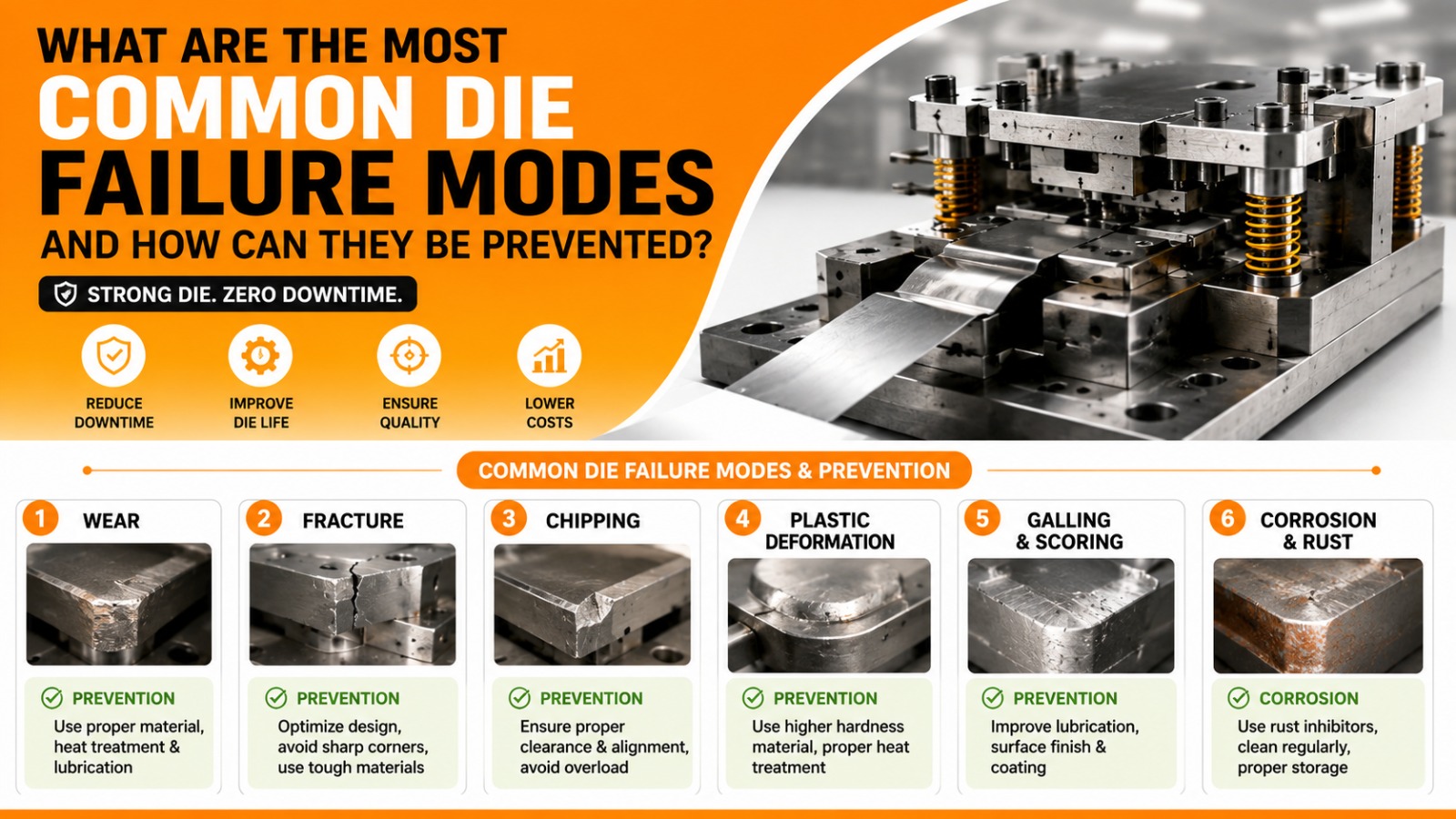
What Are the Most Common Die Failure Modes and How Can They Be Prevented?
An automotive stamping die that fails in production does not just stop producing parts — it stops the press, triggers a supply disruption, and in just-in-time supply chains, can halt a vehicle assembly line within hours. Understanding the most common die failure modes — and what engineering and maintenance decisions prevent them — is essential knowledge for every stamping engineer and production manager responsible for die performance.
Failure Mode 1: Insert Wear and Cutting Edge Degradation
What it is: Progressive loss of cutting edge sharpness on pierce punches and trim steels, causing increasing burr height, secondary shear on cut edges, and eventual punch breakage.
Why it happens: Cutting edges experience continuous compressive and shear stress. Wear increases much faster when stamping AHSS grades.
Prevention: Use correct insert materials, apply PVD or TD coatings, and replace inserts through planned preventive maintenance before failure occurs.
Failure Mode 2: Galling on Draw Die Surfaces
What it is: Adhesive transfer of sheet material onto the draw die surface, producing scratches and surface damage.
Why it happens: High contact pressure, insufficient lubrication, or soft materials such as aluminium increase galling risk.
Prevention: Apply TiN, TiCN or CrN PVD coatings, maintain Ra 0.4 surface finish, and ensure proper lubrication.
Failure Mode 3: Scrap Retention and Die Damage
What it is: Scrap remains trapped inside the die, causing severe damage when the press closes.
Why it happens: Poor scrap chute design, inadequate clearance, or air currents preventing scrap removal.
Prevention: Design positive-exit scrap chutes, use air blow-off, and reduce scrap size using step-trim geometry.
Failure Mode 4: Guide Post and Bushing Wear
What it is: Wear increases guide clearance, leading to die misalignment and dimensional inaccuracies.
Why it happens: Poor lubrication, contamination, and excessive lateral forming loads.
Prevention: Lubricate guides regularly, measure clearance during maintenance, and replace worn bushings before tolerance limits are exceeded.
Failure Mode 5: Nitrogen Cylinder Failure
What it is: Loss of nitrogen pressure reduces blank holder force, causing wrinkling, splitting, and dimensional defects.
Why it happens: Seal wear, physical damage, or failure to verify pressure before production.
Prevention: Monitor pressure before every setup, replace seals periodically, and protect cylinders from scrap impact.
Failure Mode 6: Transfer Mechanism Damage
What it is: Bent or damaged transfer fingers cause blank misalignment, collisions, and production stoppages.
Why it happens: Incorrect timing, die movement, blank changes, or fatigue from repeated loading.
Prevention: Verify transfer finger clearance after every die setup, specify suitable materials, and use anti-collision detection on servo transfer systems.
Die Failure Prevention: The Role of Planned Maintenance
Most die failures are predictable wear-related events. Preventive maintenance covering insert inspection, guide clearance measurement, nitrogen pressure checks, and transfer mechanism inspection significantly reduces unplanned downtime.
At Dai-Ichi Tools, every die programme includes a maintenance schedule defining inspection intervals and replacement criteria for all consumable components.
FAQs
How often should pierce inserts be inspected in production? Mild steel programmes should inspect inserts every 50,000 strokes, while AHSS programmes require inspection every 25,000–30,000 strokes.
What is the most common cause of unplanned die downtime? Scrap retention is one of the leading causes of unexpected downtime and is largely preventable through proper scrap chute design and regular inspection.
Does Dai-Ichi Tools provide maintenance documentation with every die? Yes. Every programme includes lubrication schedules, inspection intervals, replacement criteria, and nitrogen pressure targets.
Transfer and Tandem Die Specialists
Transfer and tandem die specialists. Every die delivered with maintenance documentation — Faridabad, India.
Request a Die Failure Prevention Consultation →