

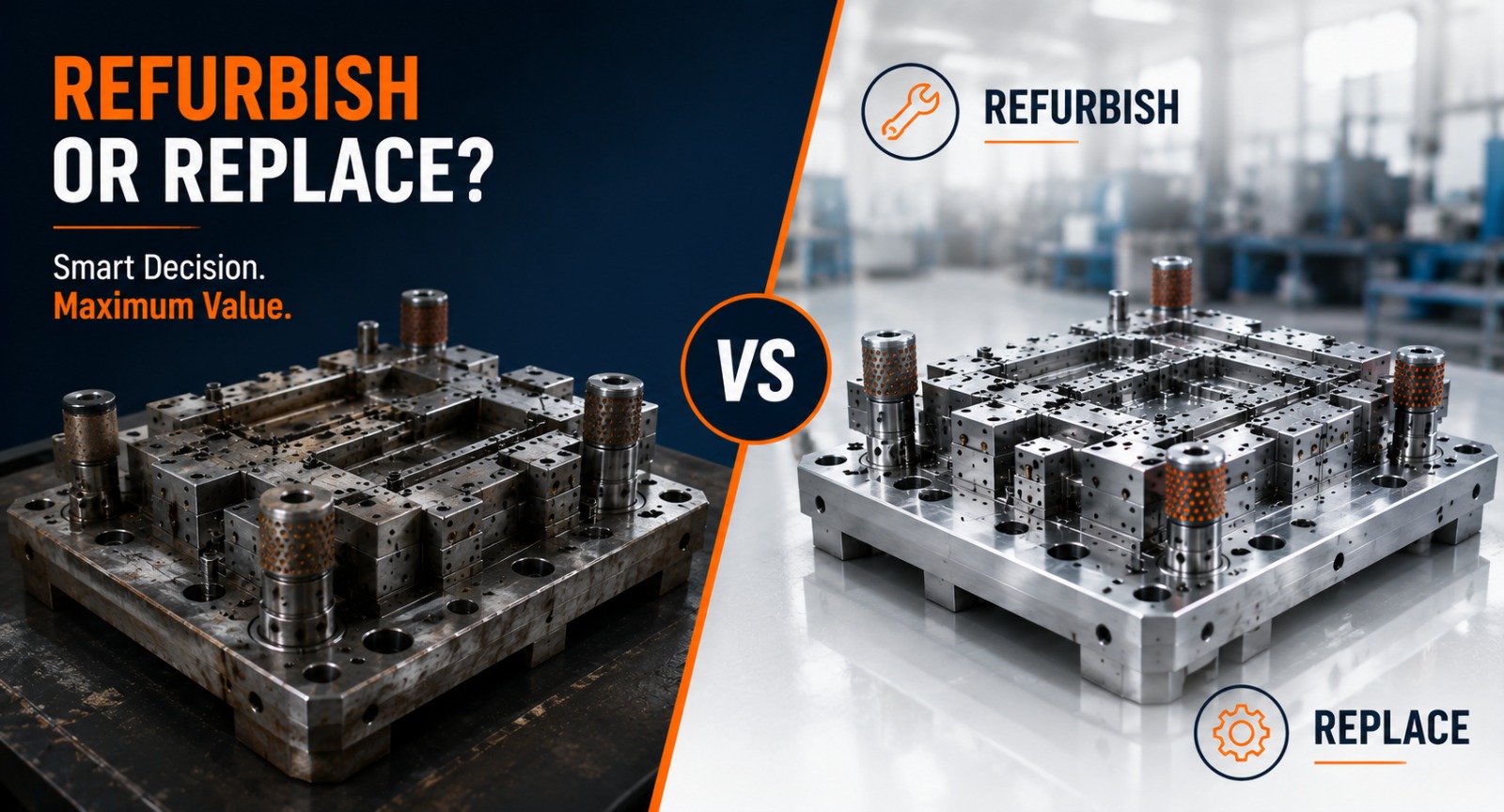
What Is Die Refurbishment and When Is It More Cost-Effective Than Building New Tooling?
Every automotive stamping die eventually reaches a stage where wear, dimensional drift, or increased scrap rates require major intervention. At that point, manufacturers must decide whether refurbishing the existing die or investing in new tooling offers the better return.
Making the right decision depends on remaining programme life, die condition, engineering changes, and total cost of ownership rather than the initial repair cost alone.
What Is Die Refurbishment?
Die refurbishment is the complete restoration of a worn stamping die so it can continue producing conforming parts for another defined production period. Unlike emergency repairs, refurbishment restores the die systematically and validates its performance before returning it to production.
- Working surface restoration and re-machining
- Complete insert replacement
- Guide system replacement
- Nitrogen cylinder overhaul
- Binder ring re-spotting
- Transfer mechanism refurbishment
- Re-tryout and dimensional validation
When Is Refurbishment More Cost-Effective?
Refurbishment delivers the best value when the programme still has significant production volume remaining, the die structure is fundamentally sound, engineering changes are minimal, and the original tooling specification was appropriate.
- Remaining production volume exceeds 40% of the original programme.
- Die shoes and structure remain free from major damage.
- Only minor or no engineering design changes are required.
- Original die specification met production requirements.
Refurbishment vs New Tooling
Cost Comparison
A refurbishment typically costs 35–55% of equivalent new tooling while significantly reducing lead time. Cost per remaining part should always be calculated using remaining production volume to determine the most economical option.
FAQs
How long does die refurbishment take? A complete refurbishment generally requires 8–14 weeks depending on die complexity, considerably shorter than the 24–36 weeks typically required for a completely new die.
Can a refurbished die perform like a new die? Yes. When refurbishment includes working surface restoration, insert replacement, and complete re-validation, dimensional performance can match the original approved tooling.
Does Dai-Ichi Tools provide refurbishment services? Yes. Dai-Ichi Tools offers complete refurbishment including inspection, re-machining, insert replacement, re-spotting, in-house tryout, and CMM validation.
Make the Right Decision: Refurbish or Replace
- Complete die condition inspection
- Working surface re-machining
- Insert replacement or upgrade
- Guide system & nitrogen cylinder overhaul
- Binder ring re-spotting
- In-house tryout up to 1,600 tonnes
- CMM re-validation
- Updated maintenance schedule
Request a Die Refurbishment Assessment → Contact Our Engineering Team →
Transfer and Tandem Die Specialists
Dai-Ichi Tools — Faridabad, India. Delivering cost-effective die refurbishment with 5-axis machining, in-house tryout, and precision dimensional validation.