

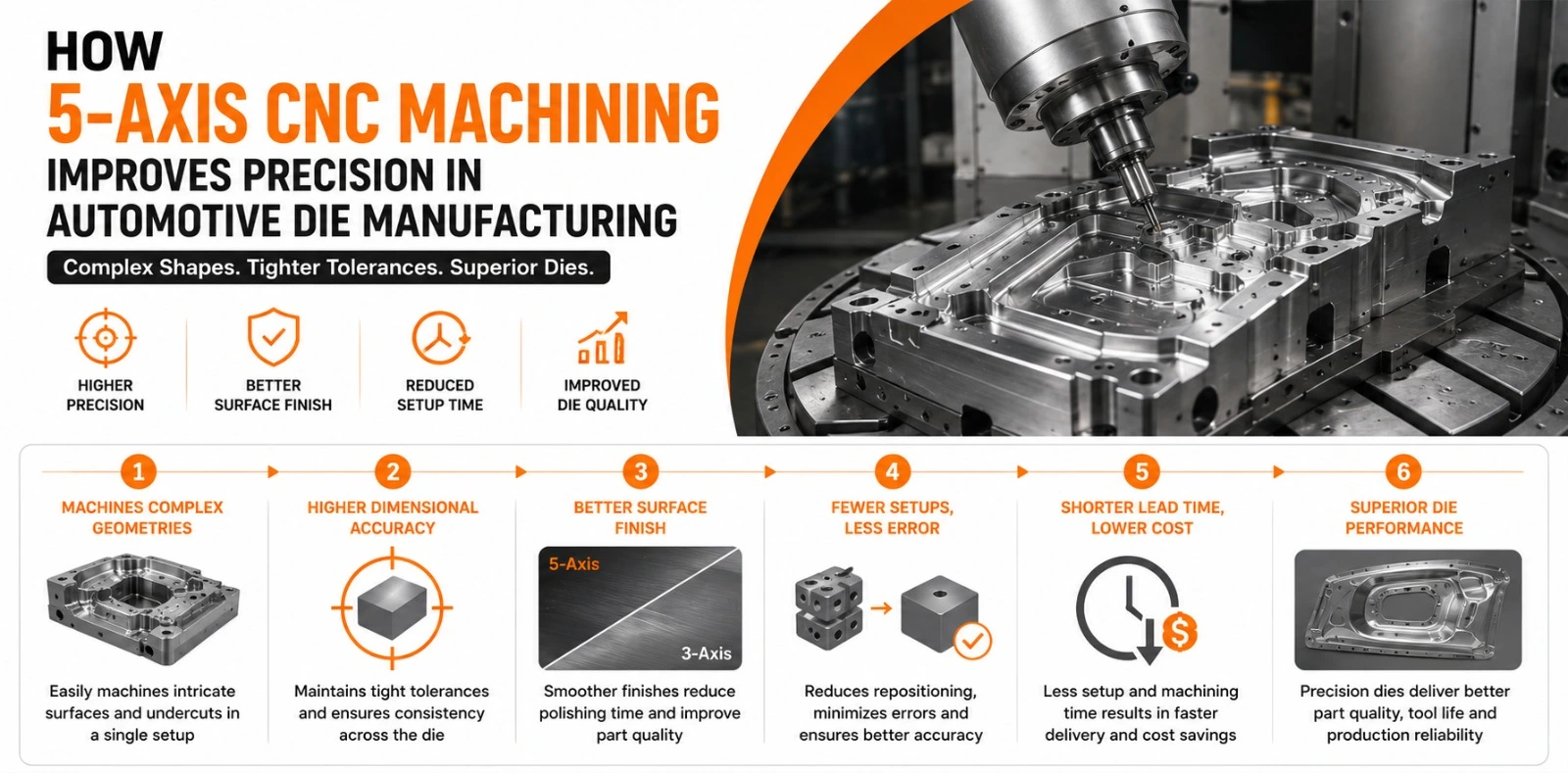
How 5-Axis CNC Machining Improves Precision in Automotive Die Manufacturing
The quality of a finished stamping die is determined more than by any other single factor by the accuracy of its working surfaces. Draw die faces compensated for springback, pierce and trim insert profiles machined to tolerance, and flange tool geometry over-bent by the predicted springback angle all depend on machining precision. The capability of the CNC machine determines whether the die produces conforming parts at tryout or requires weeks of correction.
5-axis simultaneous machining is the technology that makes modern automotive die manufacturing possible by delivering the accuracy and consistency required for complex tooling.
What 5-Axis Machining Means in Die Manufacturing
A conventional 3-axis CNC machine moves the cutting tool in X, Y, and Z directions. It is suitable for machining flat surfaces, die shoes, holders, and standard component interfaces.
A 5-axis CNC machine adds two rotational axes, allowing the cutting tool to tilt and rotate while moving simultaneously in all three linear directions. This enables the tool to remain perpendicular to complex freeform surfaces throughout machining.
At Dai-Ichi Tools, 5-axis machining is carried out on Shin Nippon Koki RB4M (3,000 × 2,000 mm) and RB3M (4,000 × 2,500 mm) VMCs, providing sufficient capacity to machine full-size transfer dies and door inner panel tooling in a single setup.
Why 5-Axis Machining Is Critical for Die Faces
Surface accuracy on freeform geometry: AutoForm-compensated die faces contain complex freeform geometry that cannot be machined efficiently on a 3-axis machine. Five-axis machining eliminates repeated repositioning and maintains tolerances of approximately ±0.02 to ±0.05 mm across the complete die surface.
Constant tool-to-surface angle: By maintaining a consistent cutter angle throughout machining, 5-axis technology produces a superior surface finish while reducing cusping and the amount of manual polishing required.
Undercut geometry accessibility: Angled surfaces, recessed profiles, and compound features can be machined directly without additional setups or specialised tooling.
Single-setup accuracy: Large die components maintain excellent positional accuracy between guide bores, insert pockets, and working surfaces because all critical features are machined in one setup.
Surface Finish and Ra Specification
- Draw die faces: Ra 0.8 or better to minimise friction and galling.
- Draw punch surfaces: Ra 0.4 or better on visible contact zones.
- Trim and pierce insert cutting faces: Ra 0.4 or better for excellent edge quality.
High-speed finishing with ball-nose cutters and fine step-over enables these surface finish requirements to be achieved directly on the machine while minimising manual polishing.
FAQs
Can transfer die faces be machined on a 3-axis machine? Simple die components can be machined on 3-axis equipment, but draw die faces, draw punch profiles, and springback-compensated flange tooling require 5-axis simultaneous machining to achieve the required accuracy and surface finish.
What machine capacity does Dai-Ichi Tools have for large die faces? Dai-Ichi Tools operates Shin Nippon Koki RB4M (3,000 × 2,000 mm) and RB3M (4,000 × 2,500 mm) 5-axis VMCs capable of machining large transfer die and door inner panel tooling in single setups.
How does 5-axis machining accuracy relate to tryout performance? Higher machining accuracy reduces the gap between the AutoForm design model and the physical die, resulting in fewer corrections during tryout and improving first-hit dimensional accuracy.
Transfer and Tandem Die Specialists
5-axis machining on Shin Nippon Koki VMCs — Dai-Ichi Tools, Faridabad, India.
Request a Precision Die Machining Quotation →