

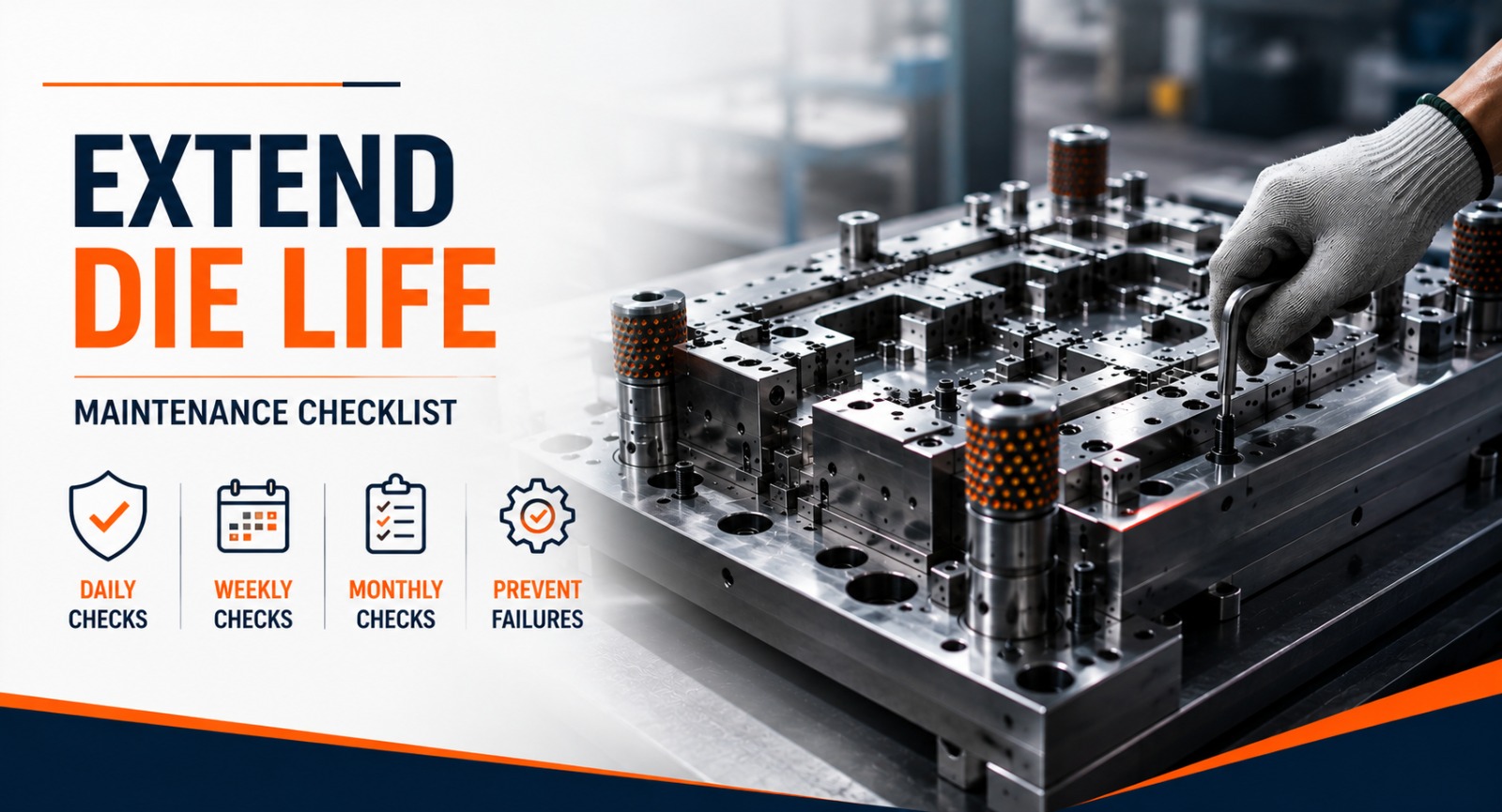
How to Extend the Service Life of an Automotive Stamping Die
An automotive stamping die is a major capital investment. Its actual return depends not only on how well it is manufactured but also on how consistently it is maintained throughout production. A structured preventive maintenance programme minimizes downtime, improves part quality, and significantly extends die life.
Why Dies Fail Prematurely
- Worn pierce and trim inserts creating excessive burrs.
- Loss of binder ring contact causing wrinkles and dimensional drift.
- Guide post and bushing wear resulting in die misalignment.
- Nitrogen cylinder pressure loss reducing blank holder force.
- Scrap retention damaging die components.
- Transfer finger wear and incorrect blank positioning.
Daily Maintenance Checklist
- Verify nitrogen cylinder pressure before every production run.
- Inspect transfer fingers for wear, cracks, or bending.
- Confirm correct lubrication type and coverage.
- Run slow-speed strokes to verify proper scrap evacuation.
Weekly Maintenance Checklist
- Inspect pierce and trim insert edges for wear or chipping.
- Check draw die surfaces for galling and scratches.
- Verify binder ring contact using spotting compound.
- Measure guide post and bushing clearance.
Monthly Maintenance Checklist
- Inspect and measure all consumable inserts.
- Bench-test nitrogen cylinders.
- Re-torque critical fasteners.
- Perform dimensional inspection on sample parts.
- Inspect transfer mechanism components.
Annual Maintenance Checklist
- Perform FARO scan of die geometry.
- Replace guide bushings on high-volume programmes.
- Inspect die shoes for fatigue cracks.
- Evaluate refurbishment requirements.
Track Die Life with Maintenance Records
Maintain stroke counters, inspection logs, replacement history, and wear-rate tracking to optimize maintenance intervals and accurately predict refurbishment requirements.
FAQs
How often should pierce inserts be replaced? On AHSS programmes, D2 inserts typically last 50,000–100,000 strokes, while carbide inserts can reach 300,000–500,000 strokes depending on production conditions.
What is the most common cause of unplanned die downtime? Scrap retention is one of the most frequent causes of unexpected downtime and can usually be prevented through proper scrap exit verification and regular inspection.
Does Dai-Ichi Tools provide maintenance documentation? Yes. Every die is supplied with inspection schedules, lubrication specifications, maintenance intervals, nitrogen pressure targets, and setup recommendations.
Build Service Life Into Every Die From Day One
- Insert specification matched to material grade
- PVD or TD surface coating recommendations
- Validated process window documentation
- Preventive maintenance schedule
- First-fill spare parts package
- CMM baseline inspection report
Request a Long-Life Die Solution → Contact Our Engineering Team →
Transfer and Tandem Die Specialists
Dai-Ichi Tools — Faridabad, India. Engineering long-life automotive tooling with preventive maintenance support for maximum production performance.