
How to Reduce Automotive Tooling Costs Without Compromising Quality
Every automotive programme operates under tooling cost pressure. The challenge is reducing tooling costs without creating quality, delivery, and production issues that become far more expensive later in the programme lifecycle.
The key is understanding which cost reductions are genuine engineering improvements and which are false economies that increase total cost of ownership.
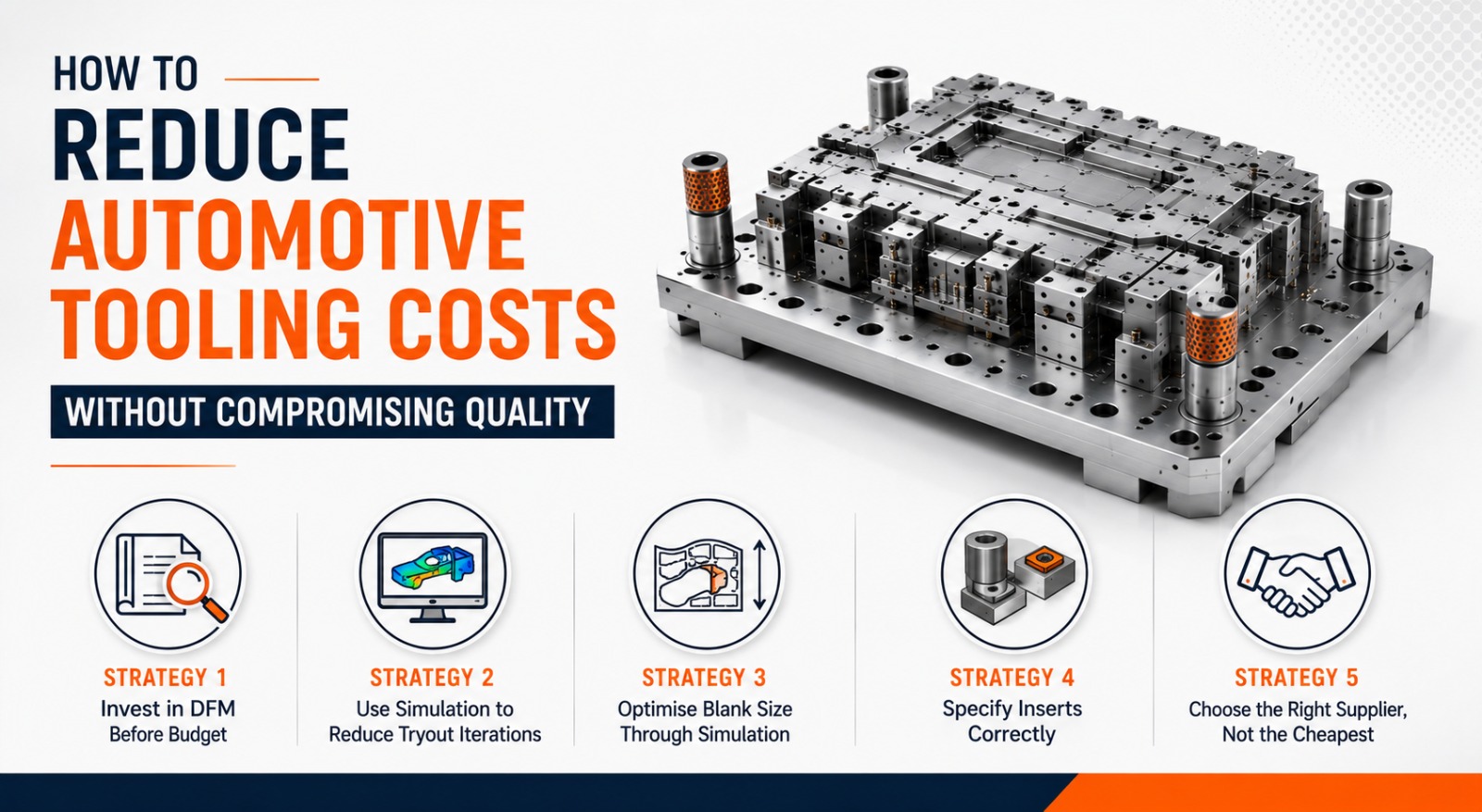
Strategy 1 — Invest in DFM Before Tooling Begins
A comprehensive Design for Manufacturability (DFM) review identifies geometry issues such as tight radii, negative draft angles, difficult flange designs, and unnecessary cam requirements before die design starts. Resolving these issues early can reduce tooling cost by 8–15% without affecting part performance.
Strategy 2 — Use Simulation to Reduce Tryout Iterations
AutoForm simulation reduces costly tryout iterations by validating material flow, springback, and forming feasibility before machining begins. Investing 3–8% in simulation can reduce tryout costs by 20–40% on complex programmes.
Strategy 3 — Optimise Blank Size
Simulation-driven blank optimisation reduces material consumption without affecting part quality. Even a 5% reduction in blank size can save tens of lakhs annually on high-volume AHSS programmes.
Strategy 4 — Specify Inserts Correctly
Choosing the correct insert material for each application avoids both unnecessary tooling cost and excessive maintenance. Carbide inserts are ideal for high-strength materials, while D2 and premium tool steels remain cost-effective for conventional applications.
Strategy 5 — Choose the Right Supplier
Selecting the lowest quotation without evaluating engineering capability often transfers costs into tryout, maintenance, and production. Evaluate suppliers based on simulation capability, machining technology, inspection systems, and in-house tryout facilities.
False Economies to Avoid
FAQs
Can tooling costs be reduced without changing part design? Yes. Simulation, blank optimisation, correct insert selection, and improved manufacturing strategy can reduce costs without requiring design changes.
How much can AutoForm simulation save? Simulation can reduce tryout iterations from three to five cycles down to one or two, often saving ₹10–30 lakh on a single AHSS programme.
Does sourcing tooling from India automatically reduce cost? Indian toolmakers can provide significant cost advantages, but supplier capability should always be verified through simulation expertise, machining infrastructure, and quality systems.
Reduce Cost Where It Is Safe — Protect Quality Where It Matters
At Dai-Ichi Tools, every programme is engineered for total cost of ownership using AutoForm simulation, DFM reviews, correct insert specification, and in-house tryout to minimise development cost while maintaining quality.
Request a Cost-Optimised Die Quotation → Contact Our Engineering Team →
Transfer and Tandem Die Specialists
Transfer and tandem die manufacturer — Faridabad, India. AutoForm simulation on every programme. In-house tryout up to 1,600 tonnes. 400+ dies annually.