
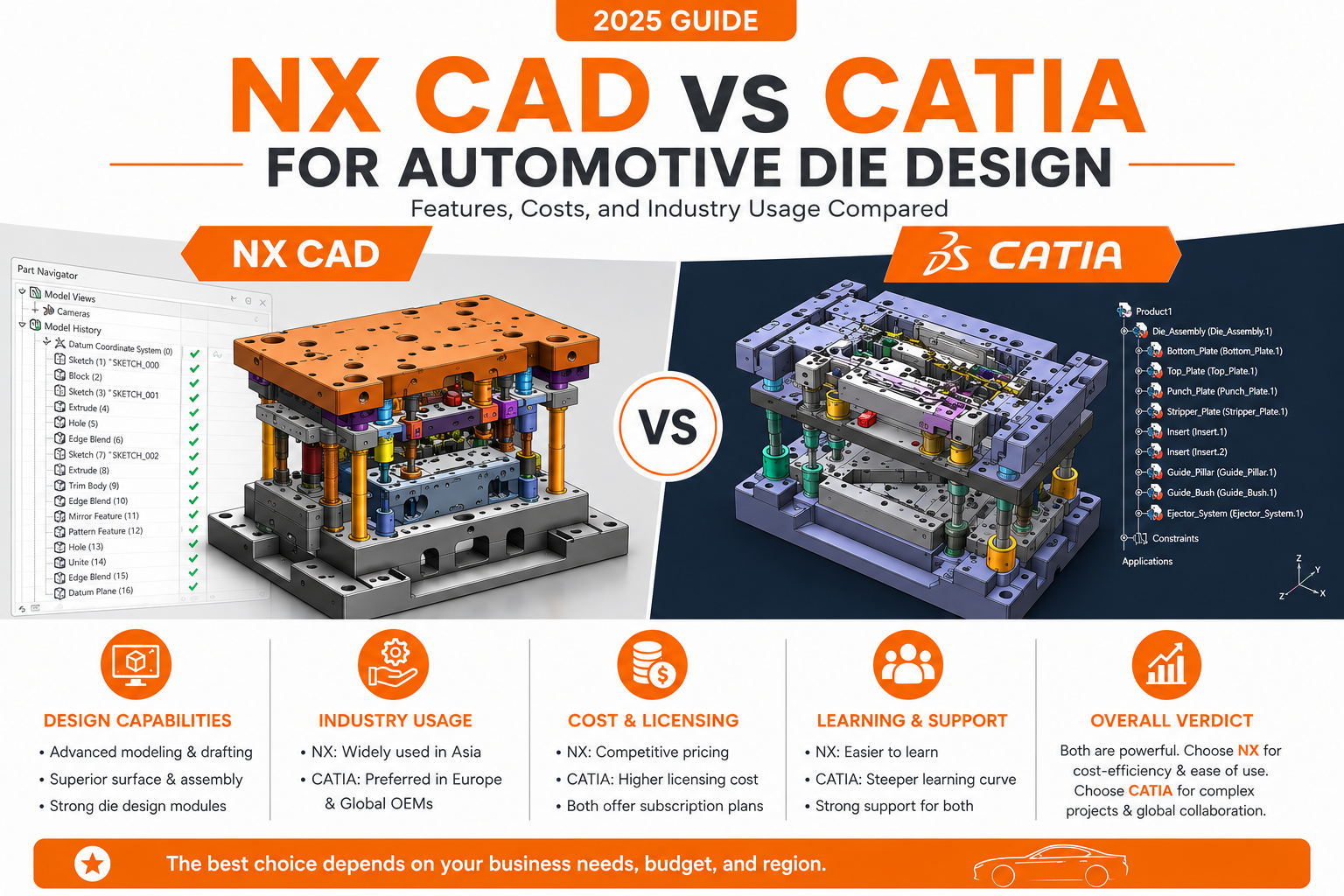
When it comes to automotive die design, choosing the right CAD software is not just a technical decision — it directly impacts production speed, tooling accuracy, and overall manufacturing cost. Two names dominate this space: Siemens NX CAD and Dassault Systèmes CATIA. Both are industry heavyweights, yet each serves different strengths depending on the manufacturer's workflow, supplier ecosystem, and regional preferences.
In this guide, we break down the real-world differences between NX and CATIA for die design, so you can make a well-informed choice.
What Is Automotive Die Design?
Automotive die design refers to the engineering process of creating precision tooling — dies, molds, and stamps — used to shape metal sheets into car body panels, structural components, and chassis parts. The dies must be dimensionally accurate to fractions of a millimeter, making the choice of CAD software critical.
NX CAD vs CATIA: A Side-by-Side Comparison
CATIA: Dassault Systèmes
CATIA: Surface modeling, aerospace & auto
CATIA: Toyota, Renault, PSA, Airbus
CATIA: Strong but requires more setup
CATIA: Requires third-party or DELMIA
CATIA: Via third-party (AutoForm)
CATIA: Yes — feature-based modeling
CATIA: Steep
CATIA: $20,000–$35,000/seat/year
CATIA: 3DEXPERIENCE Platform
CATIA: STEP, IGES, CATIA native formats
NX CAD for Automotive Die Design: Key Strengths
Siemens NX is widely regarded as the go-to platform for progressive die design, blank development, and stamping tool engineering. Here's why:
- 1. Dedicated Die Design Module: NX includes a purpose-built progressive die wizard that automates strip layout, station assignment, punch/die clearance calculations, and BOM generation. This drastically reduces engineering time for complex multi-station dies.
- 2. Synchronous Technology: NX's patented Synchronous Technology allows engineers to modify geometry directly without a full feature history rebuild — a massive productivity boost during rapid design iterations, especially in prototype die stages.
- 3. Native CAM Integration: NX seamlessly connects design to NX CAM, enabling die machining programs to be generated directly from the same 3D model. No translation errors, no data loss.
- 4. Formability & Simulation: NX integrates with AutoForm and includes its own stamping simulation tools to predict springback, thinning, and wrinkling before a single piece of steel is cut.
Who Uses NX? Ford, GM, BMW Group, Volkswagen, and most Tier-1 suppliers in Germany and North America heavily rely on NX for die and press tool design.
CATIA for Automotive Die Design: Key Strengths
CATIA has long been the benchmark for complex surface modeling and is deeply embedded in the OEM workflows of several global automakers.
- 1. Class-A Surface Excellence: CATIA's Generative Shape Design (GSD) and FreeStyle modules produce automotive-grade A-surfaces with unmatched precision — essential for outer body panel dies where aesthetic quality matters as much as dimensional accuracy.
- 2. 3DEXPERIENCE Platform: CATIA runs on Dassault's cloud-native 3DEXPERIENCE platform, enabling real-time collaboration between design, die engineering, and manufacturing teams across global locations.
- 3. Strong in Structural & Body-in-White: For body-in-white (BIW) components — door panels, hoods, fenders — CATIA's parametric environment combined with its assembly management tools gives engineers tight control over complex multi-component die assemblies.
- 4. Deep OEM Integration: Toyota, Renault, PSA Stellantis, and many Asian OEMs standardized on CATIA decades ago. For suppliers serving these OEMs, CATIA compatibility is not optional — it's a contractual requirement.
Which Software Do Manufacturers Actually Use?
The answer depends heavily on geography and OEM ecosystem:
Notable OEMs: Ford, GM, Stellantis
Notable OEMs: BMW, VW Group, Mercedes
Notable OEMs: Renault, PSA, Toyota
Notable OEMs: Hyundai, Kia
Notable OEMs: Tata, Mahindra suppliers
Notable OEMs: SAIC, BYD, Chery
The bottom line: NX dominates in die-specific tooling and manufacturing workflows. CATIA leads where complex surface design and OEM-mandated ecosystems are in play.
Cost Consideration for Die Manufacturers
For small to mid-size die manufacturers, licensing cost is a major factor. NX tends to offer more modular pricing through Siemens' Xcelerator portfolio, while CATIA's 3DEXPERIENCE licensing can be complex and expensive for tooling-focused shops. Many manufacturers investing in progressive die tooling, blanking tools, or forming dies find NX delivers a higher ROI per engineering hour.
FAQs: NX CAD vs CATIA for Die Design
Q1. Is NX better than CATIA for die design? For dedicated die and stamping tool design, NX is generally considered superior due to its built-in die design wizard, native CAM integration, and formability simulation capabilities. CATIA excels more in surface modeling and OEM design environments.
Q2. Which software is used by most automotive die manufacturers? Most Tier-1 and Tier-2 die manufacturers in North America and Europe use Siemens NX. CATIA is more common where OEM-specific requirements dictate software choice.
Q3. Can NX and CATIA exchange files easily? Yes. Both support STEP and IGES neutral formats. However, some data richness (features, parameters) may be lost in translation. Native Parasolid (NX) and CATIA V5/V6 formats are not directly interchangeable without translation tools.
Q4. Which is easier to learn for a die design engineer? Both have steep learning curves. NX's Synchronous Technology is often considered more intuitive for die-specific workflows, while CATIA's feature-based approach requires more structured training.
Q5. What CAD software does Dai-Ichi Tools recommend for die design? At Dai-Ichi Tools, our engineering teams work with precision die components designed across multiple CAD platforms. We support customer requirements whether designs are delivered in NX, CATIA, or neutral formats, ensuring accurate tooling regardless of the originating software.
Q6. Is there any free alternative to NX or CATIA for die design? There is no true free alternative for industrial die design. Some engineers explore FreeCAD or SolidWorks for basic tooling, but neither matches the specialization of NX or CATIA for production-grade automotive die work.
Final Verdict
Both NX and CATIA are world-class platforms. The right choice comes down to your OEM relationships, existing supplier ecosystem, and whether your workflow is more design-surface-driven or tooling-and-manufacturing-driven.
For most dedicated automotive die manufacturers, Siemens NX delivers the more complete, cost-effective, and manufacturing-aligned solution. But if your customer base runs on CATIA, the ecosystem lock-in is real — and investing in CATIA expertise pays off.
Looking for precision die components manufactured to exacting tolerances? Explore our capabilities at dai-ichitools.com.