

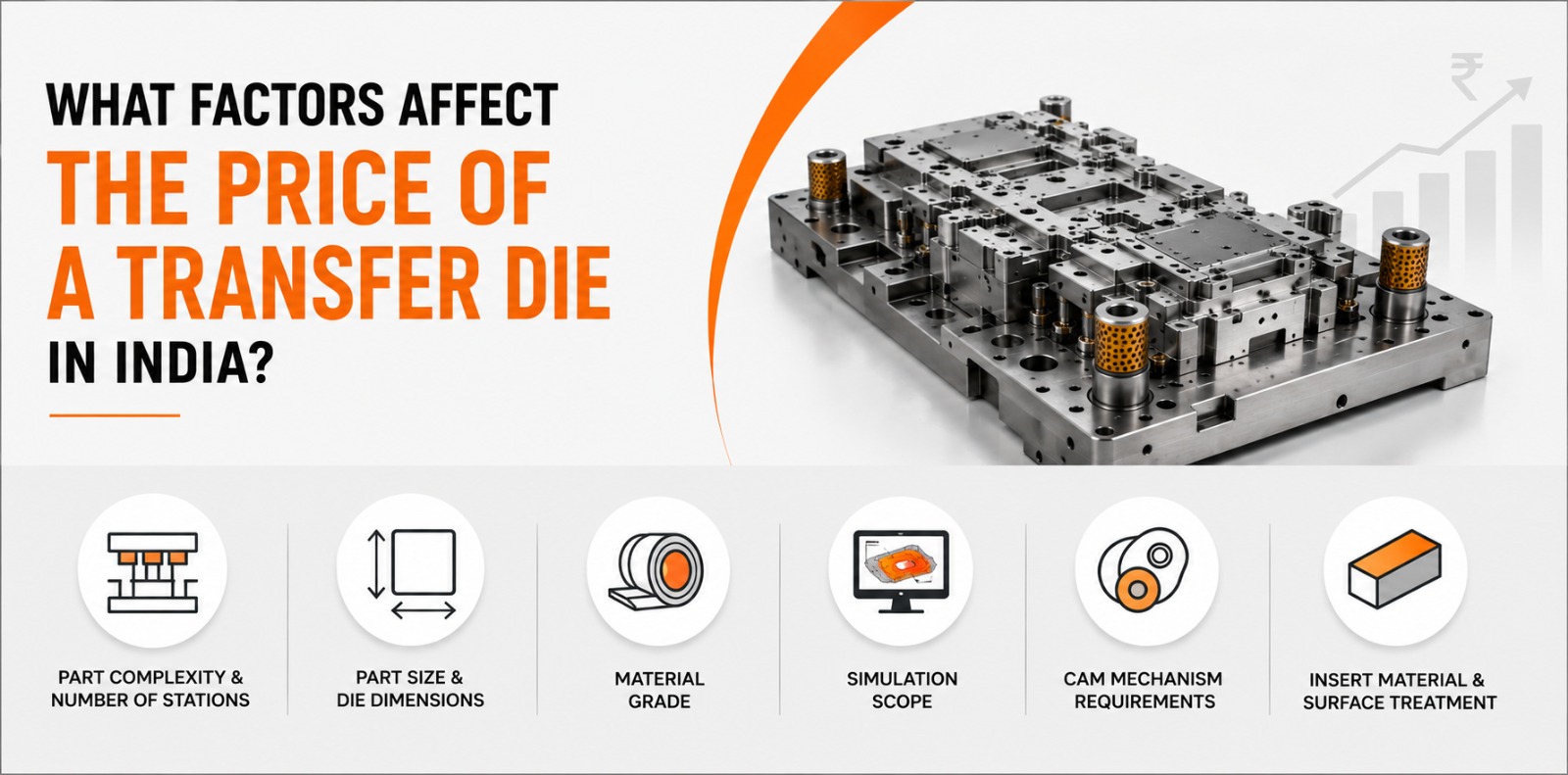
What Factors Affect Transfer Die Price in India?
Transfer die quotations from Indian toolrooms often vary by 30–50% even for apparently similar programmes. Understanding what drives pricing helps procurement teams compare quotations accurately and engineering teams make informed specification decisions.
Transfer die pricing is influenced by part complexity, material grade, simulation scope, machining capability, tryout infrastructure, engineering effort, and documentation requirements rather than by material cost alone.
Factor 1 — Part Complexity and Number of Forming Stations
Station count is the strongest cost driver. Every additional station increases design time, machining hours, assembly effort, tryout complexity, and tooling material.
Factor 2 — Part Size and Die Dimensions
Larger parts require larger die shoes, more cast iron, bigger machining centres, higher-capacity tryout presses, and specialised transportation, all of which increase programme cost.
Factor 3 — Material Grade
Material grade directly affects insert selection, surface treatment, simulation complexity, and tryout effort.
Factor 4 — Simulation Scope
Basic simulation adds only draw feasibility, whereas complete AutoForm simulation includes springback compensation, blank optimisation, forming validation, and process window development. Comprehensive simulation increases build cost slightly but significantly reduces tryout expenses.
Factor 5 — Cam Mechanisms
Every cam station introduces additional design complexity, precision machining, and assembly effort. A single cam can add ₹8–20 lakh depending on its complexity.
Factor 6 — Insert Material and Surface Treatment
Premium insert materials such as SKD11 and carbide, along with PVD coatings, increase tooling cost but provide substantially longer service life and improved production stability.
Factor 7 — Machining Capability
5-axis machining provides superior die face accuracy and surface finish compared with conventional 3-axis machining, reducing bench correction and improving tryout performance.
Factor 8 — In-House Tryout Capacity
Toolmakers with in-house 800T–1,600T tryout presses can perform correction cycles immediately, while suppliers relying on external presses often introduce weeks of delay.
Factor 9 — Design and Engineering
Engineering activities including CAD design, CAM programming, BOM preparation, and design reviews generally account for 12–18% of total transfer die cost.
Factor 10 — Documentation Requirements
APQP documentation, PPAP submissions, CMM reports, control plans, and FMEA preparation require additional engineering effort but are essential for OEM and Tier-1 approvals.
FAQs
Why do transfer die quotations vary so much? The biggest differences usually come from simulation scope, insert specification, machining capability, and tryout infrastructure rather than supplier profit margins.
Is a cheaper quotation always risky? Not necessarily, but large price differences should always be checked by comparing engineering specifications rather than total price alone.
What is a reasonable budget for an AHSS transfer die? For a 5–6 station AHSS transfer die including AutoForm simulation, 5-axis machining, CMM inspection, and in-house tryout, ₹100–180 lakh is a realistic planning range.
How does Dai-Ichi Tools prepare quotations? Every quotation is built from programme-specific engineering requirements including simulation scope, insert grades, machining hours, and tryout planning to ensure complete transparency.
Get a Specification-Transparent Transfer Die Quotation
- AutoForm R12 simulation (draw through restrike)
- Insert specification by station
- Surface treatment recommendations
- 5-axis machining on Shin Nippon Koki RB3M & RB4M
- In-house tryout up to 1,600 tonnes
- CMM & FARO inspection
- Programme schedule at order confirmation
Transfer and Tandem Die Specialists
Dai-Ichi Tools — Faridabad, India.
Get a Specification-Transparent Transfer Die Quotation →