

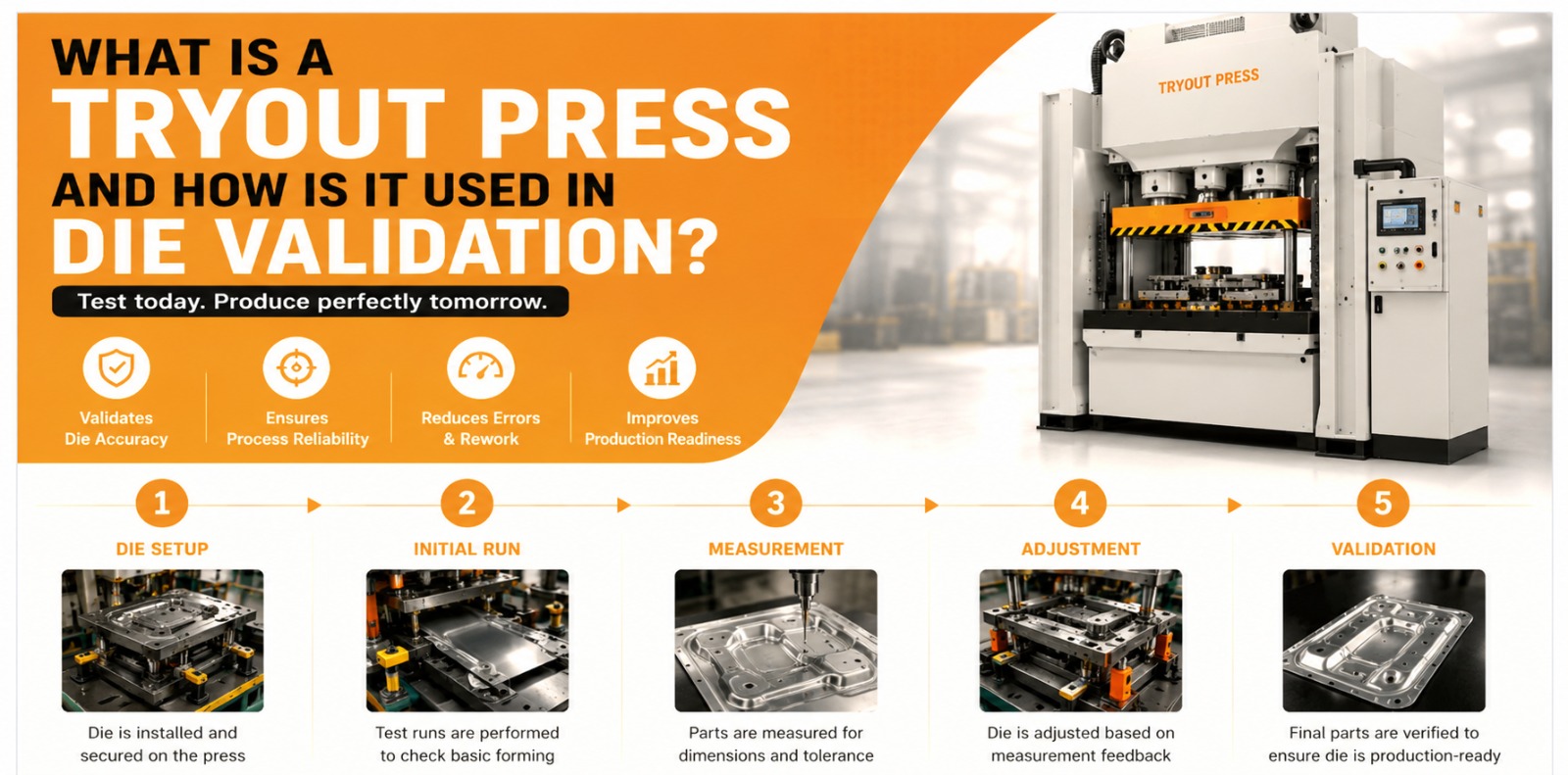
What Is a Tryout Press and How Is It Used in Die Validation?
In automotive die manufacturing, designing and machining a die to specification is not the end of the development process — it is the beginning of the validation process. Before any die is approved for production, it must be physically proven under real press conditions on real material. That validation happens on a tryout press.
What Is a Tryout Press?
A tryout press is a heavy-tonnage mechanical or hydraulic press used specifically to run newly manufactured or modified dies under controlled conditions — producing actual stampings for dimensional inspection, forming quality assessment, and process parameter validation before the die is approved for volume production.
Tryout presses are not production presses. They are engineering tools — configured for adjustability, accessibility, and flexibility rather than high-speed cycle efficiency.
- Variable stroke speed: Slow single-stroke capability allows engineers to observe forming behaviour at each stage of the press stroke.
- Adjustable die cushion: Blank holder force can be adjusted independently during tryout.
- Large bed dimensions: Accommodates the largest die sets without repositioning.
- Accessible die space: Open frame design allows engineers to inspect and modify dies easily.
At Dai-Ichi Tools, tryout is conducted on three in-house presses — KOMATSU 800T, ISGEC 1,000T, and ISGEC 1,600T — providing the tonnage and bed size range to tryout transfer and tandem die programmes without dependence on third-party facilities.
The Tryout Process: Stage by Stage
- First hit: Check mechanical interference, transfer finger clearance, and nitrogen cylinder function.
- First blank: Evaluate splits, wrinkles, trim quality, flange angles, and hole positions.
- AutoForm comparison: Compare actual part measurements with simulation predictions.
- Correction cycles: Modify die geometry and validate improvements through repeated tryout.
- Process window validation: Verify blank holder force, press speed, and blank position across production limits.
- Approval sample production: Produce 30–50 approved samples with complete CMM reports.
Why In-House Tryout Capability Matters
Suppliers without in-house tryout presses rely on third-party facilities, often adding two to four weeks of scheduling delay between correction cycles. Multiple iterations can extend programme delivery by several weeks.
In-house tryout enables engineers to modify the die in the morning and validate the correction the same day, significantly reducing overall development lead time.
FAQs
What tonnage tryout press is needed for a transfer die? Tryout press tonnage must meet or exceed the maximum simultaneous forming load of all active stations. For structural transfer dies, 800T–1,600T is typically required.
Can tryout be skipped if AutoForm simulation was thorough? No. Simulation reduces the number of iterations but cannot replace physical validation because real material and press conditions always introduce variation.
How does Dai-Ichi Tools document tryout results? Every programme includes a tryout report covering correction cycles, CMM reports, AutoForm comparison data, and validated production parameters.
Transfer and Tandem Die Specialists
Transfer and tandem die specialists. In-house tryout on presses up to 1,600 tonnes — Faridabad, India.
Request a Die Tryout Consultation →