

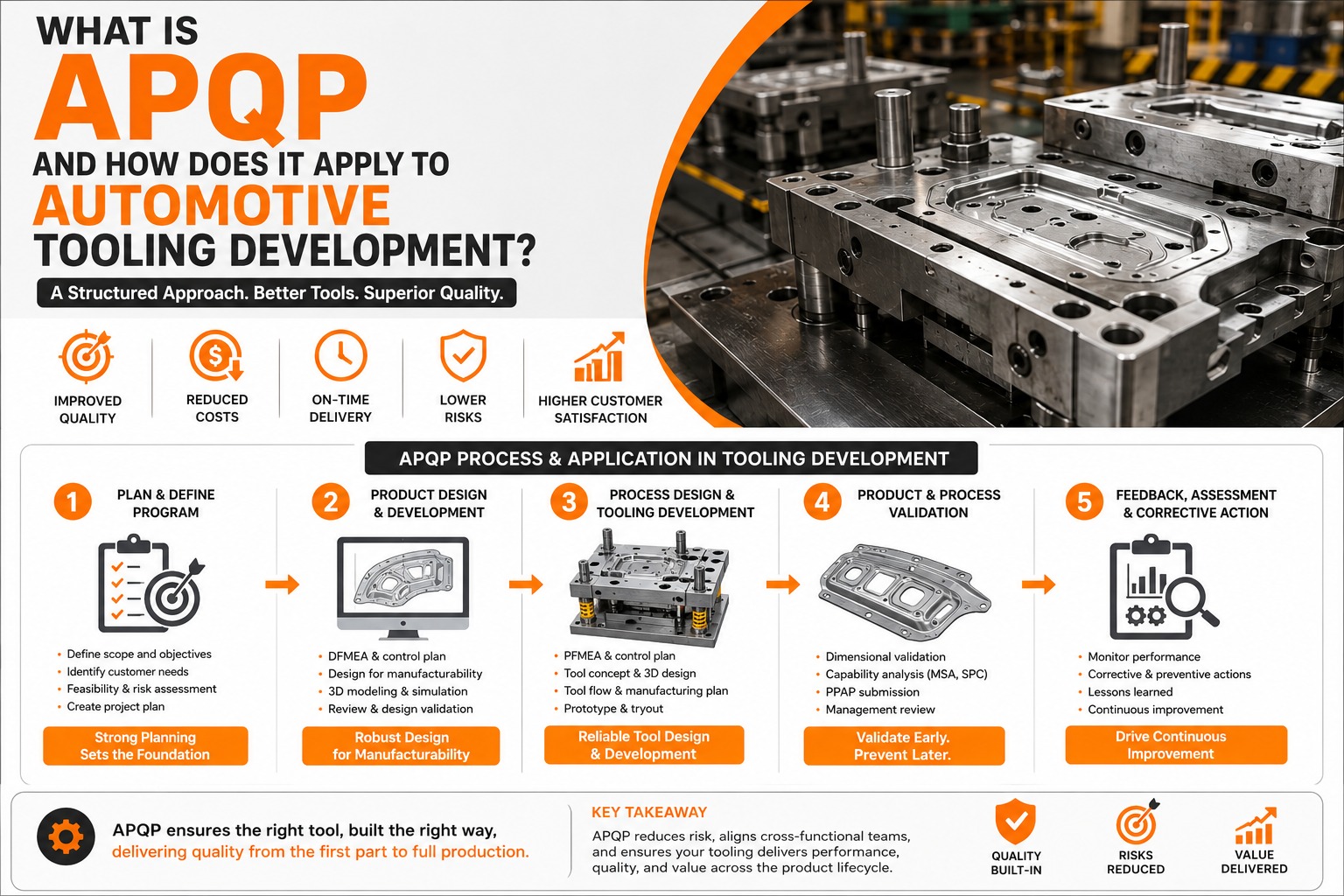
What Is APQP and How Does It Apply to Automotive Tooling Development?
In automotive manufacturing, launching a programme with tooling that has not been properly validated can result in production stoppages, delivery failures, warranty risks, and significant commercial penalties. APQP exists to reduce these risks by ensuring every stage of tooling development is planned, validated, and documented.
What Is APQP?
APQP (Advanced Product Quality Planning) is a structured framework developed by the Automotive Industry Action Group (AIAG). It defines the phases, deliverables, and approval gates required between programme award and production launch for automotive components and tooling.
APQP provides a common process framework between OEMs, Tier-1 suppliers, and tooling manufacturers, ensuring that every stakeholder understands what must be delivered, when it must be delivered, and the quality standard expected throughout the programme.
Rather than being a paperwork exercise, APQP is a risk management system. Every stage exists to eliminate predictable causes of programme failure before SOP.
The Five Phases of APQP in Tooling Development
Phase 1 — Plan and Define Programme
- Customer requirements review
- DFM review
- AutoForm feasibility simulation
- Programme timeline planning
Phase 1 establishes the foundation of the programme. Skipping feasibility reviews or DFM often results in avoidable tooling issues later in development.
Phase 2 — Product and Process Design
- Complete 3D die design
- AutoForm simulation validation
- Design FMEA
- Preliminary process flow chart
- Preliminary control plan
Phase 3 — Process Design and Development
- Die manufacturing
- Process FMEA
- Measurement System Analysis (MSA)
- Production trial planning
Phase 4 — Product and Process Validation
Phase 4 validates the completed tooling through tryout and prove-out before production begins.
- Production Part Approval Process (PPAP)
- Process capability studies (Cpk validation)
- Validated production control plan
PPAP is the formal evidence that the tooling consistently produces conforming parts and has satisfied customer approval requirements.
Phase 5 — Feedback, Assessment, and Corrective Action
After SOP, production performance is monitored continuously. Any quality issues are investigated, corrective actions are implemented, and process improvements are documented to ensure stable long-term production.
How Dai-Ichi Tools Applies APQP
Dai-Ichi Tools integrates APQP milestones into every tooling programme. DFM and feasibility studies satisfy Phase 1, AutoForm validation and Design FMEA support Phase 2, in-house tryout and CMM inspection complete Phase 4, and PPAP documentation is prepared as a standard customer deliverable.
This structured approach improves SOP readiness, reduces launch risk, and provides customers with a complete quality documentation trail.
FAQs
Is APQP mandatory for all automotive tooling programmes? APQP is mandatory for most OEM and Tier-1 supplier programmes following AIAG standards. Even where it is not contractually required, following APQP significantly reduces programme risk.
What is the relationship between APQP and PPAP? APQP is the complete planning and execution framework, while PPAP is a deliverable within APQP that provides documented proof the tooling has met customer approval requirements.
Does Dai-Ichi Tools support PPAP submissions? Yes. Dai-Ichi Tools supports PPAP Level 3 submissions including dimensional reports, material certifications, capability studies, FMEAs, control plans, and approved production samples.
Transfer and Tandem Die Specialists
Transfer and tandem die specialists. APQP-aligned programme management on every die programme — Faridabad, India.
Request an APQP-Aligned Die Programme →