

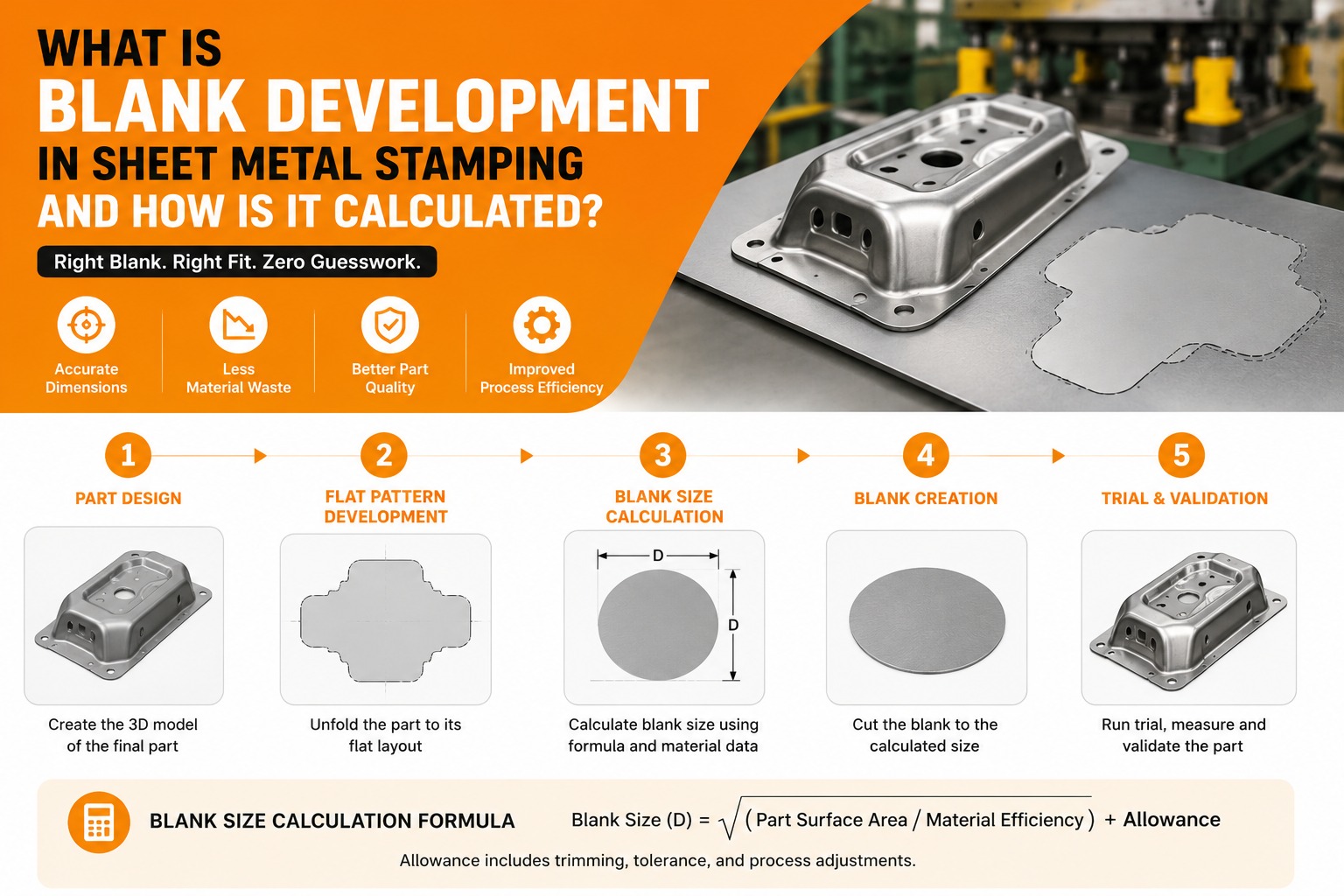
What Is Blank Development in Sheet Metal Stamping and How Is It Calculated?
Before a single forming operation takes place in a transfer die, the sheet metal blank that will be formed must be defined — its shape, size, and edge condition determined with enough precision to ensure that the forming process produces a defect-free part without wasteful over-sizing. That process is called blank development.
What Is a Blank in Sheet Metal Stamping?
A blank is the pre-cut piece of sheet metal that enters the first station of a transfer die. Unlike progressive dies, transfer dies use free blanks that are cut to a near-net shape before forming begins.
The blank is usually produced using a dedicated blanking die or laser cutter. Its outline shape and dimensions are determined during blank development before tooling design begins.
Why Blank Development Matters
Blank size directly affects both forming quality and production cost.
- Forming quality: Undersized blanks cause splits and excessive thinning, while oversized blanks create wrinkles and poor material flow.
- Material cost: Optimised blank size reduces material consumption. A 5% reduction in blank size on high-volume AHSS programmes can save ₹20–40 lakh annually.
How Blank Development Is Calculated
Traditional Method – Geometric Unfolding
The traditional method mathematically unfolds the formed component back into a flat sheet by reversing bends and draw operations. While suitable for simple parts, it is less accurate for complex three-dimensional automotive stampings.
Simulation-Based Blank Development – AutoForm
Modern automotive programmes rely on AutoForm or equivalent FEA simulation software. The software optimises the blank by repeatedly simulating the forming sequence until the smallest possible defect-free blank is achieved.
- Start with a preliminary blank shape.
- Simulate the complete forming process.
- Identify areas with excessive thinning or wrinkling.
- Adjust the blank outline.
- Repeat until a defect-free optimised blank is achieved.
Simulation-optimised blanks are typically 3–8% smaller than geometrically unfolded blanks while producing significantly better forming quality.
Blank Edge Quality Specification
Blank development also defines blank edge quality. For AHSS grades above 590 MPa, damaged sheared edges can initiate cracking during stretch flanging. Laser cutting or fine blanking is recommended where necessary.
Blank Nesting and Material Utilisation
The final stage evaluates how the blank fits within coil width to maximise material utilisation. Nesting analysis identifies opportunities to reduce waste while maintaining forming quality.
FAQs
Can blank development be done without simulation for automotive parts? Simple bracket parts can often be developed using geometric unfolding, but complex draw parts and AHSS components require simulation to accurately predict material flow.
How does blank development change for AHSS versus mild steel? AHSS has lower elongation and higher springback, requiring simulation-based optimisation and improved blank edge quality to prevent cracking.
Does Dai-Ichi Tools provide blank development as part of DFM? Yes. Every DFM review includes AutoForm blank optimisation, nesting analysis, material utilisation calculations, and blank edge quality recommendations before die design begins.
Transfer and Tandem Die Specialists
Transfer and tandem die specialists. AutoForm blank optimisation on every programme — Faridabad, India.
Request a Blank Development Consultation →