

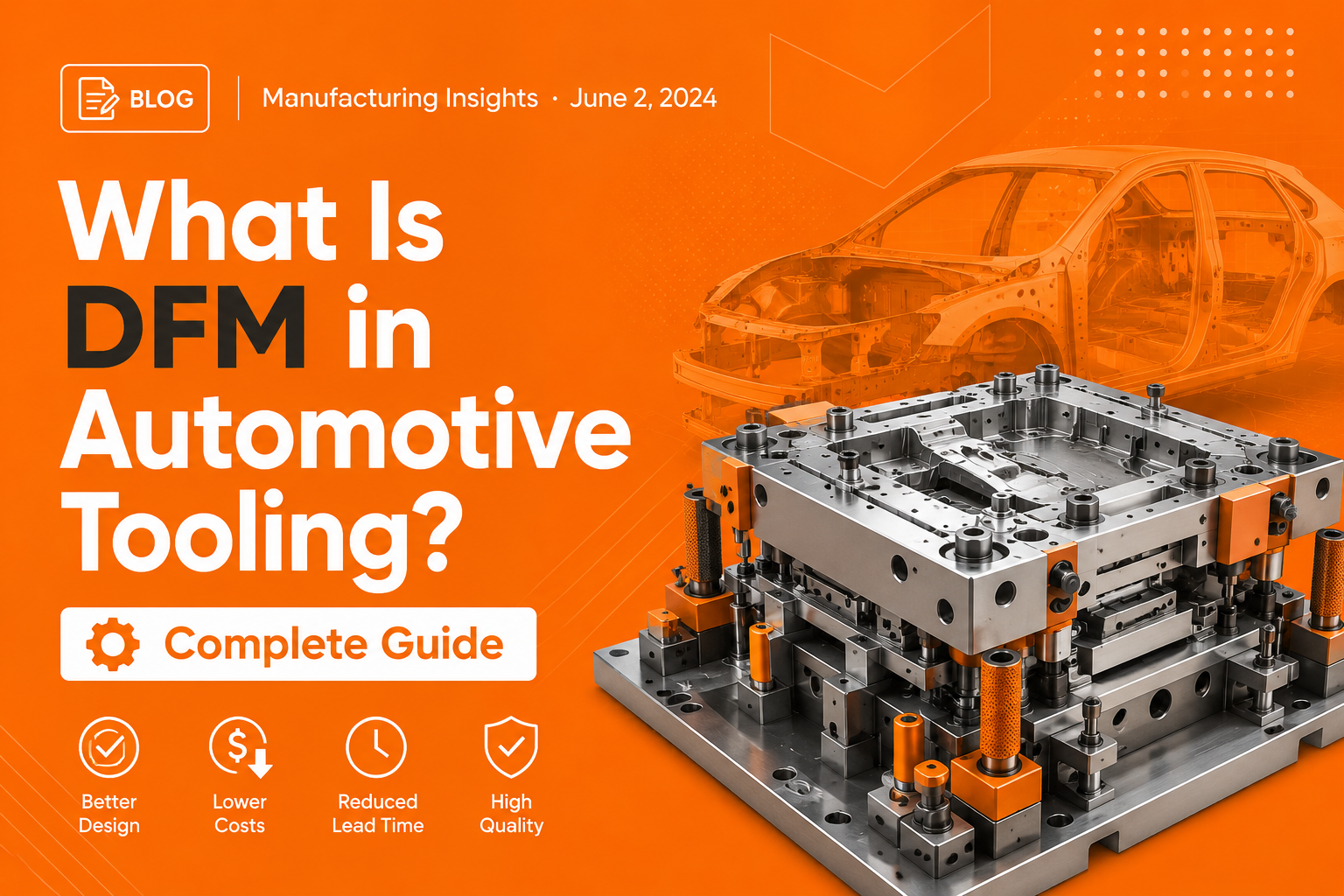
Every automotive stamping programme carries two types of cost — the cost of doing things right from the start, and the cost of fixing things that were not done right at the start.
DFM — Design for Manufacturability — is the engineering discipline that tilts every programme decisively toward the first category. It is the structured process of reviewing a part design before tooling development begins to identify and resolve every feature, geometry, and specification that will cause forming problems, dimensional failures, excessive tool wear, or avoidable cost in manufacture.
Done properly, DFM is the single highest-return engineering investment in any automotive tooling programme. Changes made at the part design stage cost a fraction of what the same changes cost at die design stage — and a fraction of a percent of what they cost at tryout. The earlier problems are found, the cheaper they are to fix.
Yet DFM is frequently treated as a formality — a checkbox exercise performed too late, with insufficient engineering depth, by a team that does not have the simulation capability to back its conclusions with data. When that happens, the costs that DFM was supposed to prevent show up instead at tryout, at first production, or — worst of all — in warranty returns from the vehicle assembly line.
At Dai-Ichi Tools, DFM is the mandatory first stage of every transfer die and tandem die programme. This guide explains exactly what DFM means in the context of automotive tooling, what it covers, how it is conducted, and why it is the most important conversation to have before any tooling budget is committed.
What DFM Means in Automotive Tooling
DFM stands for Design for Manufacturability. In automotive tooling, it refers to the systematic engineering review of a part design — its geometry, material specification, tolerances, and assembly requirements — to confirm that the part can be manufactured to specification using the planned tooling process, at the required volume, within the cost parameters of the programme.
DFM is not a single meeting or a one-page checklist. It is a structured technical process that combines engineering experience, forming simulation, and manufacturing knowledge to evaluate every aspect of a part design against the realities of the stamping process that will produce it.
The output of DFM is not a pass or fail verdict. It is a detailed technical report that identifies:
- Which features of the current part design are compatible with the planned forming process
- Which features present forming risk — potential splits, wrinkles, springback, or dimensional deviation
- Which features require design modification to be manufacturable at the required quality level
- What the impact of each identified issue will be on tooling cost, lead time, and production stability if not resolved
- What specific design changes are recommended to resolve each issue
A thorough DFM report gives the customer's engineering team exactly what they need to make informed decisions about part design before tooling investment is committed — and it gives the tooling supplier the validated technical foundation to design and build a die with confidence.
Why DFM Matters: The Cost of Late Changes
The economics of engineering change in automotive tooling follow a consistent and well-documented pattern. The cost of making a change increases by an order of magnitude at each stage of the programme.
This cost escalation is why DFM — conducted before die design begins — is universally recommended by experienced tooling engineers and consistently ignored by programme teams under schedule pressure who believe they can resolve issues later.
The issues do not resolve themselves later. They become more expensive.
What DFM Covers in Automotive Stamping
A comprehensive DFM review in automotive stamping covers every aspect of the part design that affects how the part will be formed, trimmed, flanged, and held to dimensional specification across production volume. The key areas are:
1. Part Geometry and Draw Feasibility
The first and most fundamental DFM question is whether the part can be drawn to the required depth and geometry without splitting or wrinkling within the forming limits of the specified material.
Draw feasibility analysis examines:
- Draw depth and draw ratio: The ratio of draw depth to part plan area dimensions. Parts with high draw ratios relative to their plan area require more forming stations, larger blanks, or modified geometry to achieve without exceeding material forming limits.
- Draw direction: The orientation of the part relative to the press stroke. Draw direction affects which surfaces can be formed in a single draw, where addendum geometry must be added, and how springback will distribute across the part. A poorly chosen draw direction can make an otherwise formable part unfeasible in a single draw operation.
- Radii at die entry and punch nose: Tight radii at the die entry radius or punch nose radius concentrate forming strain and cause localised thinning and splitting. DFM identifies all radii below the minimum recommended for the material grade and forming depth, and recommends increases before tooling is designed around the non-compliant geometry.
- Negative angles and undercuts: Part features that create negative draft angles relative to the press direction cannot be formed in a conventional die — they require cam mechanisms, which add cost and complexity. DFM identifies all undercut features and evaluates whether they can be eliminated by minor design modification or must be accommodated by cam tooling.
- Feature depth and proximity: Deep local features — pockets, bosses, or local draws — positioned close to the part edge or close to other features concentrate forming strain and increase split risk. DFM flags these features and recommends minimum distances from edges and between features based on material grade and part thickness.
2. Material Grade Compatibility
The specified material grade must be compatible with the forming operations required to produce the part geometry. DFM evaluates:
- Formability at specified thickness and grade: AutoForm simulation uses the material's forming limit curve (FLC) — a material-specific map of the strain combinations that cause failure — to predict whether the specified material can form the required geometry without splitting.
- Minimum bend radius compliance: Every material grade has a minimum bend radius below which the outer surface of a bend will crack. DFM checks all bend radii on the part drawing against the minimum bend radius for the specified material and thickness, and flags any non-compliance.
- Springback severity: Higher strength grades spring back more severely after forming. DFM predicts the expected springback for the material grade and part geometry, and assesses whether the springback is manageable within the planned tooling approach or whether it requires design intervention — typically increasing radii or modifying flange geometry.
- Edge cracking risk on AHSS: For AHSS grades above 590 MPa, DFM assesses all stretch-flange operations for edge cracking risk and specifies blank edge quality requirements — laser cut versus sheared — based on the predicted edge strain.
- Material substitution opportunities: In some cases, a minor increase or decrease in material grade — within the structural performance specification — can significantly improve formability or reduce tooling cost. DFM identifies these opportunities and provides the forming data to support the engineering discussion with the customer.
3. Hole, Slot, and Cutout Geometry
Holes, slots, and cutouts in formed parts are more complex than they appear on the part drawing. DFM reviews:
- Hole-to-edge distance: Holes placed too close to a part edge or a trim line will distort during forming as the material flows. Minimum hole-to-edge distance recommendations are material-grade specific — typically 1.5 to 2 times material thickness for mild steel, increasing to 3 to 4 times thickness for AHSS grades.
- Hole-to-bend distance: Holes placed too close to a flange bend line will distort when the flange is formed — producing elongated holes that fail assembly fitment. DFM specifies minimum hole-to-bend distances and recommends either repositioning the hole or moving it to a post-flange pierce operation.
- Hole diameter relative to thickness: Very small holes in thick material are difficult to pierce without punch breakage. DFM identifies holes below the minimum punch-diameter-to-thickness ratio and recommends increases where necessary.
- Slot and cutout geometry: Sharp internal corners on slots and cutouts create stress concentrations during forming that cause cracking. DFM specifies minimum corner radii for all internal cutout features.
4. Flange Geometry and Feasibility
Flange operations — bending the trimmed edges of a formed part to a specified angle — are the most common source of dimensional non-compliance in automotive stampings. DFM evaluates:
- Flange angle and length consistency: Flanges with varying length or angle along their length are more susceptible to springback variation than uniform flanges. DFM identifies non-uniform flange geometry and recommends modifications that improve consistency without compromising the part's functional requirements.
- Stretch flange assessment: Concave flange edges are subject to stretch during flanging — the outer edge of the flange must elongate to accommodate the bend. For AHSS grades, stretch flange operations are the most common source of edge cracking failures at tryout. DFM calculates the stretch ratio at all concave flanges and flags those above the safe limit for the material grade.
- Compression flange assessment: Convex flange edges are subject to compression during flanging — the outer edge must compress to accommodate the bend. Compression flanges are prone to wrinkling if the compression exceeds the material's buckling resistance. DFM identifies high-compression flanges and recommends relief cuts, notches, or geometry modifications.
- Compound angle flanges: Flanges that change angle or direction along their length require more complex tooling and are more susceptible to springback variation. DFM identifies compound angle flanges and assesses whether simplified geometry is achievable within the part's functional requirements.
5. Tolerance Analysis
Part drawings in automotive stamping carry dimensional tolerances that must be achievable with the planned tooling process. DFM reviews:
- Achievable tolerance by feature type: Different features have different achievable tolerance ranges in stamping. Pierced hole positions can typically be held to ±0.2 to ±0.3 mm. Formed surface positions are more sensitive — achievable tolerances on formed surfaces are typically ±0.5 to ±1.0 mm without special process control, depending on material grade and part geometry.
- GD&T datum scheme review: The datum scheme — the set of surfaces and holes that define the measurement reference frame for all tolerances — must be achievable and stable in the stamping process. Datums placed on highly formed or flexible surfaces are problematic. DFM reviews the datum scheme and recommends relocating datums to flat, stable surfaces where necessary.
- Assembly interface tolerances: Critical assembly interfaces — mating flanges, assembly holes, and reference surfaces — carry the tightest tolerances on the part drawing. DFM specifically assesses whether these features can be produced to the required tolerance with the planned tooling and process, and flags any that require process capability analysis or additional tooling investment.
- Tolerance stack-up in multi-station dies: In a transfer die with 6 to 8 stations, dimensional variation accumulates across stations. DFM performs a tolerance stack-up analysis to confirm that the final part dimensional specification is achievable within the cumulative variation of the multi-station forming process.
6. Blank Development and Material Utilisation
DFM includes an initial blank development analysis that:
- Defines the preliminary blank shape and size required to form the part without defect
- Calculates the material utilisation rate — the percentage of purchased sheet material that becomes finished part versus scrap
- Identifies opportunities to improve material utilisation through blank shape optimisation
- Assesses blank nesting efficiency for coil-fed blanking operations
For high-cost materials including AHSS and aluminium, material utilisation is a significant programme cost driver. A 5 percent improvement in material utilisation on a 200,000 parts per year programme in 980 MPa AHSS can save several million rupees annually — a saving that is only achievable if blank optimisation is addressed at DFM stage, not after tooling is built.
7. Forming Sequence Recommendation
DFM concludes with a recommended forming sequence — the station-by-station operation plan for the transfer die or tandem die programme. The forming sequence recommendation covers:
- Number of forming stations required
- Operation at each station — draw, pierce, trim, flange, restrike, cam, emboss
- Recommended press direction and draw direction
- Transfer mechanism type recommendation — 2-axis finger, 3-axis crossbar, or servo crossbar
- Press specification requirements — minimum tonnage, bed size, stroke, cushion capacity
- Estimated tooling cost range and programme lead time based on the confirmed forming approach
This forming sequence recommendation is the bridge between DFM and die design. Once the customer approves the recommended forming sequence — with any agreed part design modifications incorporated — the die design phase can begin with a validated technical foundation.
The DFM Process: How It Works at Dai-Ichi Tools
At Dai-Ichi Tools, DFM is a structured engineering process, not an informal discussion. The process follows a defined sequence:
Step 1 — Data receipt and review: Customer provides 3D part model (CATIA, NX, or STEP format), 2D drawing with tolerances and GD&T, material specification, annual volume, press specification if known, and any customer-specific tooling standards. Our engineering team reviews the data package for completeness before DFM begins.
Step 2 — AutoForm feasibility simulation: AutoForm R12 simulation is run on the part geometry to assess draw feasibility, thinning distribution, split and wrinkle risk, and springback prediction. Simulation results provide the quantitative data that backs every DFM recommendation — replacing engineering opinion with engineering evidence.
Step 3 — Geometry review: The engineering team reviews all part features — radii, flange geometry, hole positions, undercuts, and tolerances — against manufacturing capability and material grade requirements. Issues are categorised by severity: critical (must be resolved before tooling design begins), major (should be resolved, alternative tooling solutions available), and minor (noted for information, manageable within planned tooling approach).
Step 4 — Blank development: Preliminary blank shape and size is developed from the simulation results. Material utilisation rate is calculated. Blank optimisation opportunities are identified and quantified.
Step 5 — Forming sequence definition: Recommended forming sequence is developed — station count, operation at each station, press requirements, transfer mechanism recommendation.
Step 6 — DFM report issue: A comprehensive DFM report is issued covering all findings, simulation evidence, design change recommendations, forming sequence recommendation, and preliminary tooling cost and lead time indication. The report is structured for presentation at a customer design review.
Step 7 — Design review and sign-off: DFM findings are reviewed with the customer engineering team. Agreed design changes are incorporated into the part model. Forming sequence is approved. Die design phase begins.
Common DFM Findings in Automotive Stamping Programmes
Based on our experience across hundreds of automotive die programmes, these are the most frequently identified DFM issues:
Impact: Splitting at tryout — die rework required
Impact: Hole distortion — assembly rejection
Impact: Edge cracking — multiple tryout cycles
Impact: Dimensional rejection — restrike station required
Impact: Increased tooling cost and complexity
Impact: Process capability failure in production
Impact: Measurement instability — false rejections
Impact: Redraw station required — additional cost
Impact: Material cost higher than necessary
Impact: Punch breakage in production
DFM vs Design Review: What Is the Difference?
DFM is frequently confused with a standard design review (DR) — but the two are different in scope, timing, and output.
DFM: Confirm manufacturability with planned process
DFM: Before tooling design begins
DFM: Tooling supplier engineering team
DFM: Simulation, forming analysis, blank development
DFM: Manufacturing feasibility report with specific recommendations
DFM: Can the part be made to the design requirement?
A design review confirms that the part design is correct. A DFM review confirms that the part design can be manufactured. Both are necessary — but they answer different questions and should not be confused or combined.
FAQs: DFM in Automotive Tooling
When should DFM be performed in the programme timeline? DFM should be completed before die design begins — ideally at the point when the part geometry is sufficiently developed for simulation but before it is frozen for tooling release. In practice, the best time is immediately after the part concept is approved and the 3D model is available in a form that can be simulated. The later DFM is performed, the more expensive any resulting design changes become.
Who should conduct the DFM review? DFM should be conducted by the tooling supplier — the organisation that will design and manufacture the die — not by the customer alone. The tooling supplier has the forming process knowledge, simulation capability, and manufacturing experience to identify issues that a part design team without stamping expertise may not recognise. Customer involvement is essential for reviewing DFM findings and approving design changes, but the technical analysis must be supplier-led.
How long does a DFM review take? For a typical automotive structural part in a transfer die programme, a comprehensive DFM review — including AutoForm simulation, geometry review, blank development, and forming sequence recommendation — takes 1 to 3 weeks depending on part complexity. This timeline is insignificant compared to the weeks or months that unresolved DFM issues add to tryout.
What data does Dai-Ichi Tools need to conduct a DFM review? Dai-Ichi Tools requires the 3D part model in CATIA, NX, or STEP format, the 2D drawing with all tolerances and GD&T annotations, the material specification including grade, thickness, and mechanical property requirements, the annual production volume, and any customer-specific die standards or press specifications if known at the time of DFM.
Can DFM be conducted if the part design is not yet finalised? Yes — and in many cases, conducting DFM on a preliminary design is more valuable than waiting for design freeze. Early DFM findings can influence the part design in ways that significantly improve formability and reduce tooling cost — but only if those findings are available before the design is locked. Dai-Ichi Tools conducts DFM on preliminary designs with the understanding that findings are based on the current geometry and will be updated when the design is finalised.
Does DFM guarantee a first-time-right tryout? DFM significantly improves the probability of first-time-right or single-correction tryout by resolving the forming issues that cause the majority of tryout failures before tooling is built. However, DFM alone does not guarantee first-time-right tryout — it must be combined with rigorous forming simulation during die face design, high-quality machining, and disciplined tryout management. At Dai-Ichi Tools, DFM combined with full AutoForm sequence simulation consistently achieves first-time-right or single-correction tryout results on programmes where this combined approach is applied from the start.
What does a DFM report from Dai-Ichi Tools include? A Dai-Ichi Tools DFM report includes AutoForm simulation results with thinning, FLD, and springback plots; a geometry findings table listing all identified issues by severity with specific recommendations; blank development drawing with material utilisation calculation; forming sequence recommendation with station-by-station operation plan; press specification requirements; and a preliminary tooling cost and lead time indication based on the confirmed forming approach.
Start Every Programme With DFM — Not With Regret
The most expensive words in automotive tooling are: "we should have caught that at DFM."
They are spoken at tryout, when a die that has taken 24 weeks and significant investment to build cannot produce a part that meets the drawing. They are spoken at production launch, when a process that was never properly validated begins generating scrap that disrupts the customer's assembly line. They are spoken in warranty reviews, when a dimensional non-conformance that originated in an unresolved forming issue reaches the vehicle fleet.
DFM does not prevent all problems. But it catches the predictable ones — the geometry that cannot be formed, the tolerance that cannot be held, the material that will crack at the flange — before tooling budget is committed and before the programme clock is running.
At Dai-Ichi Tools, DFM is not an optional service or an introductory discussion. It is the engineering foundation that every die programme is built on — conducted with AutoForm R12 simulation, backed by decades of transfer and tandem die manufacturing experience, and delivered as a comprehensive technical report that gives your engineering team everything needed to make informed decisions before the tooling investment begins.
If you have a new automotive stamping programme and want to start with the right engineering foundation, our team is ready to begin the DFM process as soon as your part data is available.
What every Dai-Ichi DFM review includes:
- AutoForm R12 feasibility simulation — thinning, FLD, and springback analysis
- Complete geometry review — radii, flanges, holes, undercuts, and tolerances
- Blank development with material utilisation calculation
- Forming sequence recommendation with station-by-station operation plan
- Press specification requirements
- Preliminary tooling cost and lead time indication
- Comprehensive DFM report structured for customer design review presentation
📍 Dai-Ichi Tools — Faridabad, India