

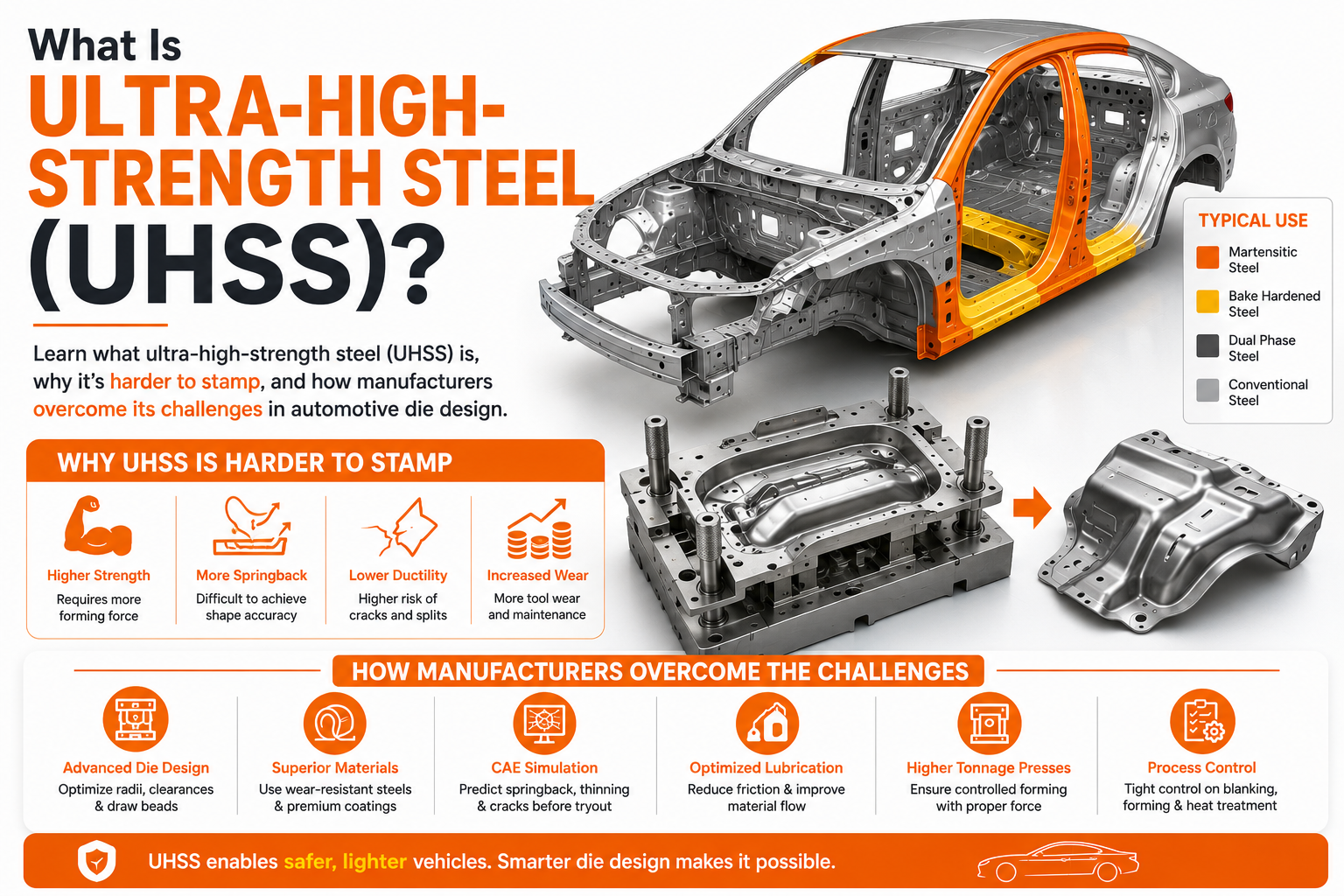
The automotive manufacturing industry is under constant pressure — build cars that are lighter, safer, and more fuel-efficient, all without inflating production costs. Ultra-high-strength steel (UHSS) has emerged as one of the most powerful answers to that challenge. But while UHSS solves many engineering problems on paper, it creates a set of very real headaches on the production floor — especially during stamping.
If you work in die design, press tool manufacturing, or automotive forming, you need to understand exactly what UHSS is, how it behaves differently from conventional steel, and why it demands a fundamentally different approach to stamping.
What Is Ultra-High-Strength Steel (UHSS)?
Ultra-high-strength steel (UHSS) is a category of advanced high-strength steel (AHSS) with a tensile strength exceeding 780 MPa, and in many grades reaching beyond 1,500 MPa. To put that in perspective, conventional mild steel used in automotive panels typically has a tensile strength of around 140–280 MPa. UHSS is three to ten times stronger.
UHSS is not a single material — it is a family of steel grades engineered through precise alloying and heat treatment processes to achieve exceptional strength-to-weight ratios. Common types include:
Primary Application: Structural reinforcements
Primary Application: Door intrusion beams
Primary Application: A/B pillars, roof rails
Primary Application: Crash-relevant structural parts
Primary Application: Energy-absorbing zones
Why Is UHSS Used in Automotive Manufacturing?
The automotive industry adopted UHSS primarily to meet two competing demands: crash safety regulations and fuel efficiency/emissions targets.
Using UHSS allows OEMs to reduce part thickness (and therefore weight) while maintaining or improving the structural integrity required to pass crash tests like Euro NCAP and IIHS. A door pillar made from 1,500 MPa press-hardened steel can be significantly thinner and lighter than the same part in mild steel — while being far stronger.
Key benefits driving UHSS adoption:
- Up to 25–30% weight reduction per component versus mild steel equivalents
- Meets stringent side-impact, rollover, and frontal crash safety requirements
- Supports global emissions compliance (lighter vehicle = lower fuel consumption)
- Enables thinner gauge parts without structural compromise
- Compatible with multi-material vehicle architectures alongside aluminium and composites
By 2025, UHSS and AHSS grades account for over 60% of the steel used in a modern vehicle body structure — a figure that continues to rise.
Why Is UHSS Harder to Stamp?
This is where UHSS gets complicated for die manufacturers and press shop engineers. The very properties that make UHSS desirable — extreme strength, high hardness, complex microstructure — are exactly what makes it so challenging to stamp. Here are the core reasons:
1. Springback
Springback is the elastic recovery a sheet metal undergoes after the forming load is removed. In conventional steel, springback is manageable and predictable. In UHSS, the extremely high yield strength means the material stores far more elastic energy during forming — and releases it aggressively when the die opens.
The result: a stamped part that doesn't hold its intended geometry. A flange designed at 90° might spring back to 95° or beyond. Correcting this requires significant die compensation, iterative tryout, and sometimes complete die redesign.
2. Increased Forming Forces
Stamping UHSS demands significantly higher press tonnage than conventional steel of the same thickness. A part that might stamp comfortably at 500 tonnes in mild steel could require 1,200 tonnes or more in UHSS — straining press capacity and tooling integrity.
3. Reduced Formability and Ductility
UHSS has significantly lower elongation (ductility) compared to mild steel. Mild steel might have 35–45% total elongation; many UHSS grades fall between 5–15%. This limited formability means complex geometries that are straightforward in mild steel — deep draws, tight radii, sharp flanges — risk cracking, necking, or splitting when attempted in UHSS.
Die radii must be increased, draw depths reduced, and part geometries sometimes redesigned entirely to accommodate the material's limits.
4. Accelerated Die Wear
The hardness and abrasiveness of UHSS causes significantly faster die wear than conventional materials. Die surfaces in contact with UHSS experience higher compressive and abrasive loads, leading to galling, scoring, and surface degradation much earlier in the production cycle.
This demands the use of premium die materials (such as D2, DC53, or powder metallurgy tool steels), advanced surface coatings (TiN, TiCN, TD coatings), and more frequent die maintenance intervals.
5. Heat Generation During Forming
High forming pressures generate substantial heat at the die-material interface during UHSS stamping. This heat can accelerate die wear, affect material properties at the contact zone, and create dimensional inconsistencies across a production run — particularly at high stroke rates.
Hot Stamping: The Solution for the Highest UHSS Grades
For the most extreme UHSS grades — particularly press-hardened boron steel (22MnB5) used in A/B pillars and roof rails — cold stamping is often not feasible at all. The solution is hot stamping (press hardening).
In hot stamping, the blank is heated to approximately 900–950°C (austenitizing temperature), transferred rapidly to a water-cooled die, and simultaneously formed and quenched. This transforms the steel's microstructure from austenite to martensite, achieving tensile strengths of 1,500–1,800 MPa in the finished part with excellent geometric accuracy and minimal springback.
Hot stamping eliminates most of the cold-forming challenges of UHSS but introduces its own engineering requirements: heated blank handling systems, water-cooled die tooling, precise thermal management, and significantly higher capital investment.
Key Challenges Summary: UHSS Stamping vs Conventional Steel
UHSS: High, requires die compensation
UHSS: 2–4× higher
UHSS: Low — limited complex geometry
UHSS: Accelerated — premium tooling needed
UHSS: Significant at high production rates
UHSS: High on complex geometries
UHSS: D2, DC53, PM tool steels + coatings
How Die Manufacturers Adapt for UHSS
Successfully stamping UHSS requires a holistic approach across die design, tooling material selection, and process engineering:
- Die Design Adaptations: Increased punch/die radii, draw bead optimization, blank holder force management, and geometry compensation for springback built directly into the die surface.
- Tool Steel Selection: High-performance tool steels with superior wear resistance and compressive strength — D2, DC53, Vanadis 4 Extra, or ASP powder metallurgy grades — are essential for UHSS dies expected to run high volumes.
- Surface Coatings: Physical vapor deposition (PVD) coatings such as TiN, TiCN, or CrN dramatically extend die surface life by reducing friction and abrasive wear.
- Simulation Before Tryout: Advanced FEA-based forming simulation tools (AutoForm, PAM-STAMP) are non-negotiable when working with UHSS. Springback prediction, thinning analysis, and failure risk mapping must be completed digitally before any physical die tryout begins.
- Lubrication: Specialized forming lubricants designed for high-pressure UHSS applications reduce galling and heat buildup at the die surface, protecting both tooling and part quality.
FAQs: Ultra-High-Strength Steel and Stamping
Q1. What tensile strength classifies steel as ultra-high-strength? Steel with a tensile strength of 780 MPa or above is generally classified as ultra-high-strength steel (UHSS). Grades used in safety-critical automotive structures can reach 1,500–1,800 MPa.
Q2. What is the biggest challenge in stamping UHSS? Springback is the most significant and persistent challenge. The high yield strength of UHSS causes the part to elastically recover substantially after forming, making dimensional accuracy difficult to achieve without extensive die compensation.
Q3. Can conventional stamping presses handle UHSS? Some lower-grade UHSS (DP780) can be cold-stamped on high-tonnage conventional presses. However, the highest UHSS grades (press-hardened steel) require either purpose-built presses or hot stamping lines with heated blank handling and water-cooled tooling.
Q4. Why does UHSS cause more die wear? The extreme hardness and forming pressures involved in UHSS stamping generate higher contact stresses and abrasive action at the die surface, leading to faster surface degradation compared to dies used with mild steel.
Q5. What die material is best for UHSS stamping? Premium tool steels such as D2, DC53, and powder metallurgy grades like Vanadis 4 Extra or ASP23 offer the best combination of wear resistance and compressive strength for UHSS die applications. These are typically complemented with PVD surface coatings.
Q6. Is UHSS used in electric vehicles (EVs)? Yes. UHSS adoption is actually accelerating in EV manufacturing, where battery protection structures, door intrusion systems, and underbody reinforcements increasingly use press-hardened steel grades to achieve structural integrity without adding excessive weight.
Q7. How does Dai-Ichi Tools support UHSS die requirements? At Dai-Ichi Tools, we manufacture precision die components engineered to handle the demanding conditions of UHSS stamping — including high-wear die inserts, precision ground tool steel components, and custom tooling solutions built to your specific material and production requirements.
Conclusion
Ultra-high-strength steel has fundamentally changed automotive manufacturing — enabling lighter, safer vehicles while meeting ever-tightening emissions regulations. But it has also raised the bar significantly for everyone involved in stamping and die design. The combination of high springback, elevated forming forces, limited ductility, and accelerated die wear means that stamping UHSS successfully demands precision engineering at every stage — from material selection and die design to simulation, tooling, and process control.
For die manufacturers who master UHSS, the opportunity is enormous. The automotive industry's shift toward advanced high-strength steels shows no sign of slowing — and the suppliers who invest in the knowledge, tooling, and processes to handle these materials reliably will be the ones building the future of automotive manufacturing.
Need precision die components built for high-strength steel applications? Explore our capabilities at dai-ichitools.com.